A lot is being talked about Tokenization of Real World Assets being the next wave of the crypto market. Many online are traders and just a fraction are aware of what happens behind their trading interfaces. If just the US Equity market alone is ported On-Chain by blockchain technology, that will be ~$84 trillion made globally accessible. A market does not grow to that size without regulatory clarity for all participants involved alongside penalties for nefarious players. Blockchain is becoming a fundamental infrastructure technology that will update the current financial system, but before we even talk about Tokenization, how about having a basic understanding of how markets *(US Stock Market)*actually work from the time you click/tap "buy". This article seeks to answer three questions. 1. How does a private company become a publicly tradable investment? 2. What actually happens after an investor clicks “Buy”? 3. Who protects, records, moves, and ultimately controls the investor’s cash and securities? *This article applies a fiduciary-style educational standard—putting clarity, risk disclosure, and investor protection ahead of promotion. It is general education, not individualized investment, legal, or tax advice.* --- Most investors think the stock market is their brokerage app. It's the front door. Every trade you place passes through at least three other institutions before it's actually yours: - an *exchange*that matches your order, - a *market maker* that supplies the liquidity to fill it instantly, and - a *clearing house* that settles the trade and records who really owns what. Before any of that can happen, a company has to go through a multi-year private journey — funding, underwriting, SEC registration, and pricing — just to earn the right to have a ticker symbol at all. Understanding this infrastructure will not tell you which stock will outperform. It will help you understand where your money goes, how ownership is recorded, who profits from your order, what protections apply, and what can still go wrong. --- ## Part I: Before a Company Becomes a Stock A stock doesn't appear on an exchange out of nowhere. A company is legally formed and issues initial shares to its founders. At this point: - Ownership is private. - Shares cannot normally be purchased through a public exchange. - Valuation is negotiated rather than continuously discovered by public trading. The company may also reserve shares for employees through a stock-option or equity-incentive plan. ### Private funding The founders raise money from angel investors and venture capital in exchange for equity. Ownership exists only on a private cap table. Each financing round can introduce new shareholders, preferred-share rights, board representation, liquidation preferences and dilution for existing owners. A rising private valuation does not automatically mean the business is profitable or that public investors will later receive the same price. ### Underwriter selection The company hires investment banks to structure the offering and, in a traditional IPO, commit to buying shares to resell to the public. Their job is not to guarantee that the investment will succeed. Their job is to prepare, structure, review and distribute the offering within the applicable legal framework. The underwriters and company have considerable discretion over IPO allocations. Retail investors are not guaranteed access to shares at the IPO price. ### SEC registration (Form S-1) The company legally discloses its financials, risks, and business model. This is the transparency requirement that has to be satisfied before the public can be sold shares at all. SEC(Security and Exchange Committee) review should not be mistaken for investment approval. Registration is a disclosure process; it does not mean the SEC believes the shares are fairly valued or likely to appreciate. ### Roadshow and pricing The underwriters pitch institutional investors to gauge demand and land on an initial offering price. IPO or direct listing — shares are sold and the stock begins trading on a public exchange. This is the moment a private company becomes a publicly traded one. This is where two markets must be distinguished: - ***Primary market:***The company or selling shareholders initially sell the offered shares. - ***Secondary market:*** Investors subsequently buy and sell shares among themselves. If you purchase the stock days later through your brokerage account, your money usually goes to another seller, not directly to the company. 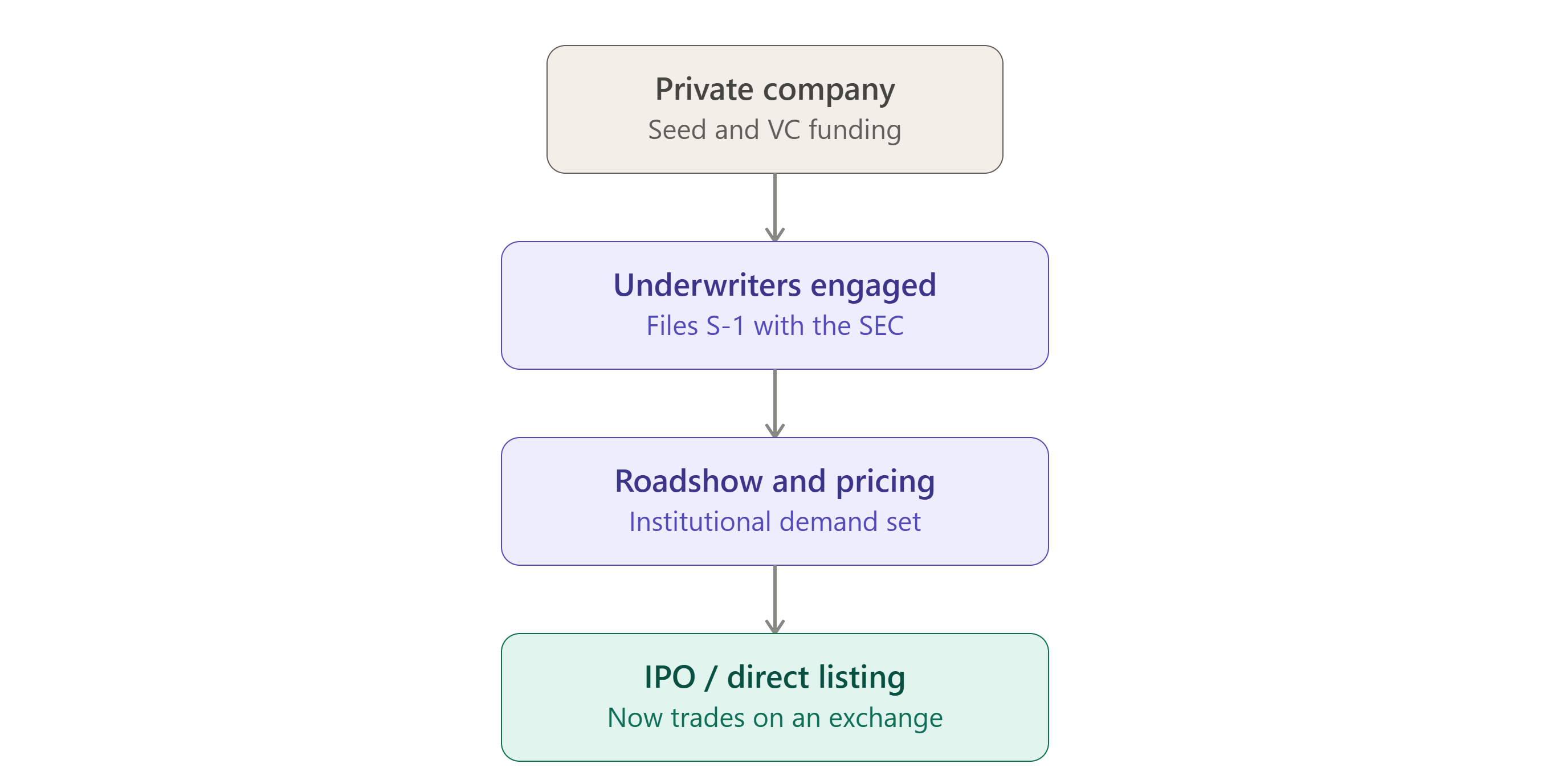 Becoming public creates continuing obligations. You have ongoing disclosures that create visibility. They do not eliminate fraud, governance failures, valuation risk or business failure. *NB: There are other paths to being listed other than an IPO such as direct-listing, SPAC Merger, Spin-off, up-listing that are beyond the scope of this paper.* --- ## Part 2: What Happens After You Hit "Buy" Once a stock exists, your brokerage account is only the interface. Placing an order sets off a sequence of events involving three institutions that operate almost entirely out of public view. 1. **The Broker**(Market Access) A broker connects customers with the securities market. Its three key roles: *Account administration:* Maintains customer records, tax information and regulatory documentation. *Order handling*: Validates and routes buy or sell instructions. *Customer-asset administration*: Holds or arranges custody of cash and securities and processes corporate actions. A broker must use reasonable diligence to seek the most favorable reasonably available result under prevailing market conditions. “Best execution” is not necessarily synonymous with the fastest execution or the venue paying the broker the most. 2. **The Exchange**(Price Discovery) The New York Stock Exchange, Nasdaq, and their electronic peers are marketplaces, not custodians. Their job is to match a buyer's bid with a seller's ask and record the price at which that match happened. The exchange never takes possession of your money or your shares — it's the mechanism for price discovery, not the mechanism for ownership. Exchanges play the following roles: **Price discovery:** Matches buying and selling interest to establish executable prices. **Liquidity provision:** Help investors transact without waiting for an identical investor order. **Trade execution:** Creates a binding transaction between buyer and seller. An exchange is not a broker. An exchange provides a regulated marketplace and matching infrastructure. It does not generally maintain the ordinary retail investor’s brokerage account. ### 3. The Market Maker(where liquidity comes from) If every trade had to wait for a perfectly matching counterparty to show up at the same instant, markets would be painfully slow. Market makers (firms like Citadel Securities and Virtu) solve this by standing ready to buy or sell almost instantly, profiting off the small spread between the price they buy at and the price they sell at. Many retail brokers route your order to a specific market maker in exchange for payment — a practice called *payment for order flow.* It's legal and disclosed, but it's also a place where the broker's incentive (getting paid for routing) and your incentive (best possible execution price) aren't automatically the same thing. But, the broker must still consider execution quality rather than simply directing orders to the highest-paying destination. ### 4. The Clearinghouse (where ownership actually changes hands) This is the layer almost nobody knows exists, and it's arguably the most important one from a fiduciary standpoint. The ***Depository Trust & Clearing Corporation*** (DTCC) and its subsidiaries confirm both sides of the trade, move the cash, and update the official record of who owns what. In the US, most trades settle within one business day (T+1). Key functions of the DTCC include: *Trade comparison and obligation calculation:* Determines what firms must deliver and receive. *Netting*: Combines many transactions into smaller net obligations. *Counterparty-risk management:* Interposes itself between clearing members for eligible trades and manages completion risk. *Netting* means firms do not need to move cash and shares separately for every individual customer trade. Clearing reduces operational complexity. It does not make the financial system incapable of failure. 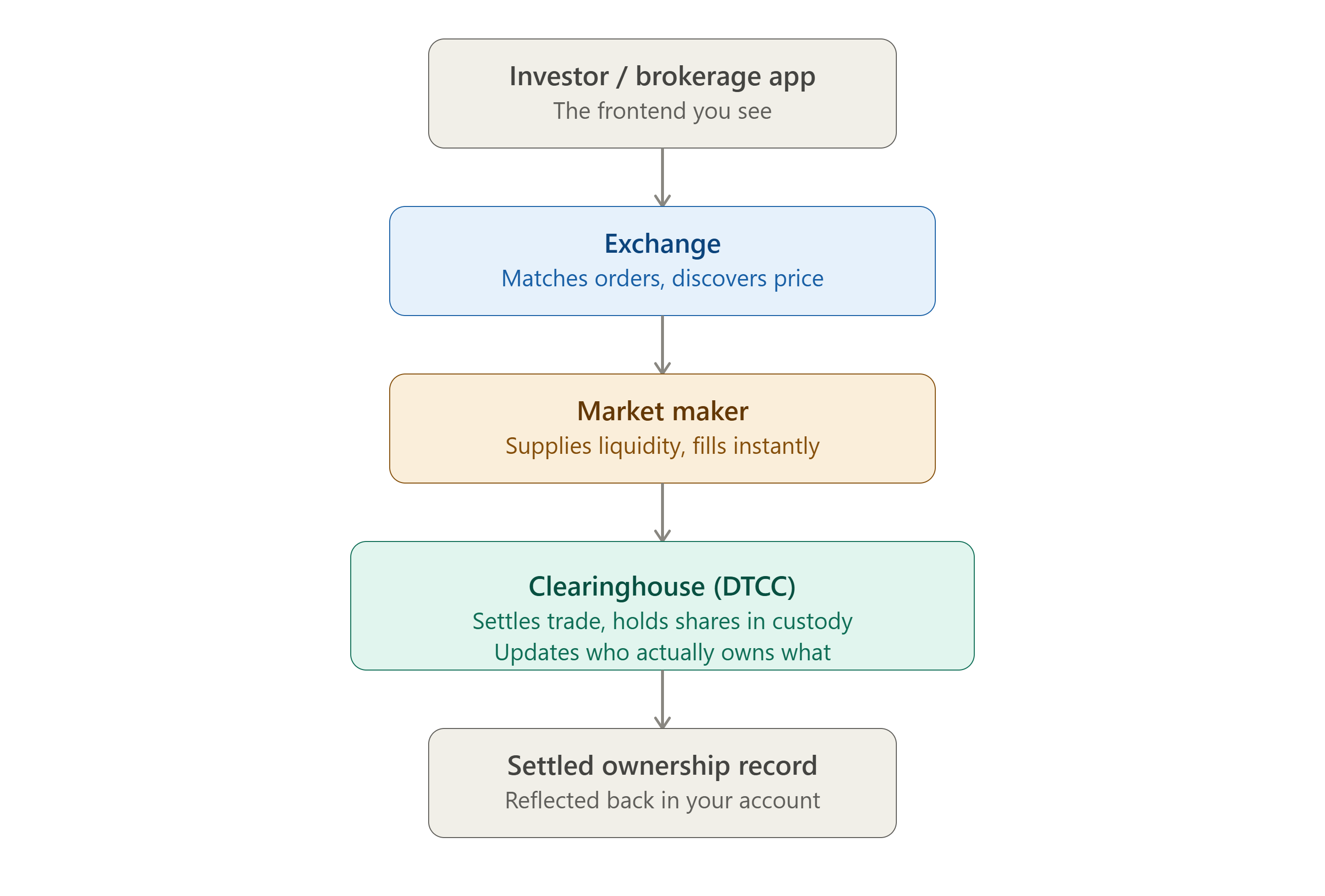 ***Important:*** you almost never hold a physical stock certificate with your name on it. Shares are typically held in street name — registered to the depository, with your brokerage keeping an internal ledger showing you as the beneficial owner. This is precisely why a brokerage's financial trouble doesn't automatically mean your shares disappear; the ownership record lives a layer above the broker itself, at the depository. --- ### Why Separating these functions matter Each player in this stack has a different incentive structure, and no single player is watching out for you the way a fiduciary would: The *broker* may be compensated for where it routes your order, not purely for getting you the best price. The *market maker* profits from the bid-ask spread; the smaller the spread it can capture, the better for it, not necessarily for you. The *exchange* is optimizing for a functioning, liquid marketplace not for your individual outcome. The *clearing house* is the one layer built purely for the integrity of settlement. It has no stake in price or execution quality, only in making sure the trade that was agreed to actually happens. --- ## The Custody and ownership records This is the layer investors misunderstand the most. Your brokerage statement may say that you own 100 shares. But the issuer’s shareholder register may not display your personal name. Most U.S. retail investors hold securities in street name: - The security is held through a broker or other intermediary. - The investor is the beneficial owner. - The broker maintains the customer-level ownership record. - DTC maintains participant-level positions. - Securities deposited at DTC are commonly registered under its nominee, Cede & Co. DTCC explains that DTC records participant ownership, while participants maintain the underlying investor records. Its key roles include: ***Safekeeping:***Reduces reliance on physical certificates. ***Ownership accounting:*** Maintains linked records from issuer to depository, participant, broker and customer. ***Asset servicing:*** Supports dividends, stock splits, proxy materials and other corporate actions. 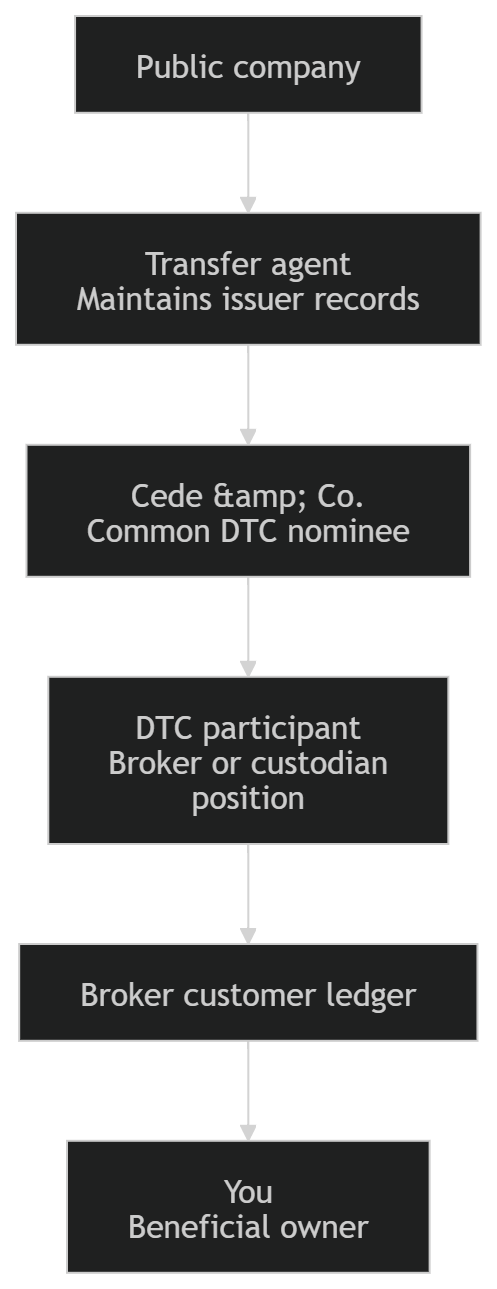 This structure makes trading and settlement efficient, but it means several ledgers must agree. A transfer agent works for the issuer to maintain security-holder records, record ownership changes and help process distributions. It is not a brokerage or trading venue. --- ## Regulation, Oversight and Investor Protection The market is not supervised by one all-powerful institution. The exchange, the market maker, the clearinghouse — operates inside a web of oversight that most investors never think to look for. It isn't one agency quietly supervising everything. It's a division of labor, where different bodies watch different parts of the system, and understanding who does what tells you where your real protections actually come from. Its three key roles ***Rulemaking and supervision:*** Establishes conduct, disclosure, capital and market-integrity requirements. ***Examination and enforcement:*** Reviews firms and pursues potential violations. ***Failure resolution and customer recovery:***Provides processes for complaints, arbitration and eligible brokerage-failure claims. 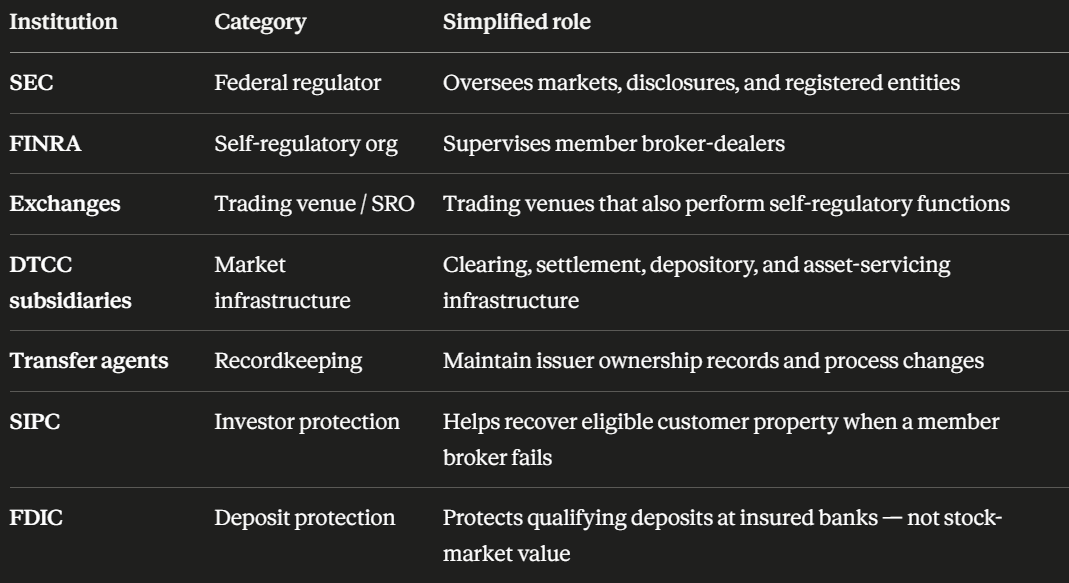 Every layer catches a different kind of failure. - The SEC and FINRA catch bad conduct. - The DTCC's oversight catches infrastructure failure. - SIPC catches broker insolvency. None of them catch a stock simply losing value — that risk stays yours, by design. --- ## What Happens When Something Goes Wrong? None of these institutions are designed to tell you what to buy, if the stock you bought will be profitable or not. All they do is ensure fair play and punish nefarious players with measures appropriate to the degree of their misconduct. By design, it is your responsibility to do your due diligence before parting with your hard earned money. There is recourse if failure is systemic, but hardly if its due to negligence on your part as an uninformed investor. ### Below are 5 key things you should know as an investor: 1. *The app is only an interface.* Identify the broker, carrying firm, custodian and cash arrangement behind it. 1. *Execution is not settlement.* “Filled” confirms a trade, while settlement completes the transfer obligations. 1. *You are usually a beneficial owner.* Your broker’s records connect your ownership to the wider depository and issuer-record system. 1. *Protection depends on the type of failure.* SIPC, FDIC insurance and customer-asset segregation address different risks. None protects against an investment declining in value. 1. *Every layer has incentives.* Commission-free trading, cash sweeps, order routing, margin and securities lending can generate revenue for intermediaries. Read the disclosures before accepting the defaults. --- The stock market is an ownership, information and settlement system built from interconnected private institutions, regulated entities and public oversight. Your brokerage account makes that system feel instantaneous. Behind the screen, however, an order must be validated, routed, executed, cleared, settled, recorded and serviced. The responsible investor does not need to become a market-structure expert. But you should know who holds your assets, how your orders are handled, how the intermediaries are paid, which protections apply and where those protections stop. That knowledge may not predict the next winning stock, but it can prevent avoidable mistakes before your money ever reaches the market.