TL;DR: An attacker reportedly spent about $4.4 million acquiring enough BONK to control a low-participation governance vote. They then used Proposal BIP #76 to authorize the transfer of approximately 4.426 trillion BONK worth around $20–21 million from the BonkDAO treasury. The transactions followed the DAO’s programmed rules: *no private key was stolen, the BONK token contract was not compromised, and user wallets were not directly drained. *The failure was in the governance design surrounding the treasury. --- Most crypto security stories begin with stolen private keys, malicious code, phishing, or a vulnerability in a smart contract. The BonkDAO incident was different. The attacker did not need to break the DAO’s governance system. They reportedly acquired enough voting power to operate it as designed. **What is a DAO?** A DAO—Decentralized Autonomous Organization—is an internet-based organization that uses blockchain rules and community voting to coordinate decisions. Instead of relying entirely on a traditional management team, eligible members typically use governance tokens to vote on proposals. Approved proposals may allocate treasury funds, change protocol rules, or authorize other onchain actions. “Decentralized” does not necessarily mean leaderless or completely automated. Many DAOs still depend on developers, elected councils, multisignature signers, delegates, and legal entities. ### Key Roles of a DAO *Protocol governance* Members vote on upgrades, fees, risk settings, incentives, and other operating rules. *Treasury management* The DAO decides how community-controlled funds should be held, spent, invested, or distributed. *Ecosystem funding* It may provide grants and incentives to developers, researchers, educators, liquidity providers, and other contributors. *Community representation* Token holders can propose ideas, debate priorities, elect delegates, and influence the project’s direction. *Coordination and accountability* Proposals, votes, and treasury transactions can be recorded onchain, making organizational decisions more transparent and auditable. > A DAO is only as decentralized and secure as its token distribution, voter participation, governance rules, and treasury controls. --- On June 30, 2026, an anonymous wallet submitted BIP #76, “Sowellian BonkDAO,” through BonkDAO’s governance system on Solana’s Realms platform. The proposal presented itself as a plan to reform governance, introduce new leadership, monetize treasury holdings, and reward participating voters. But beneath that language was the instruction that mattered: transfer approximately 4,426,104,450,305 BONK from the community treasury to a designated wallet. [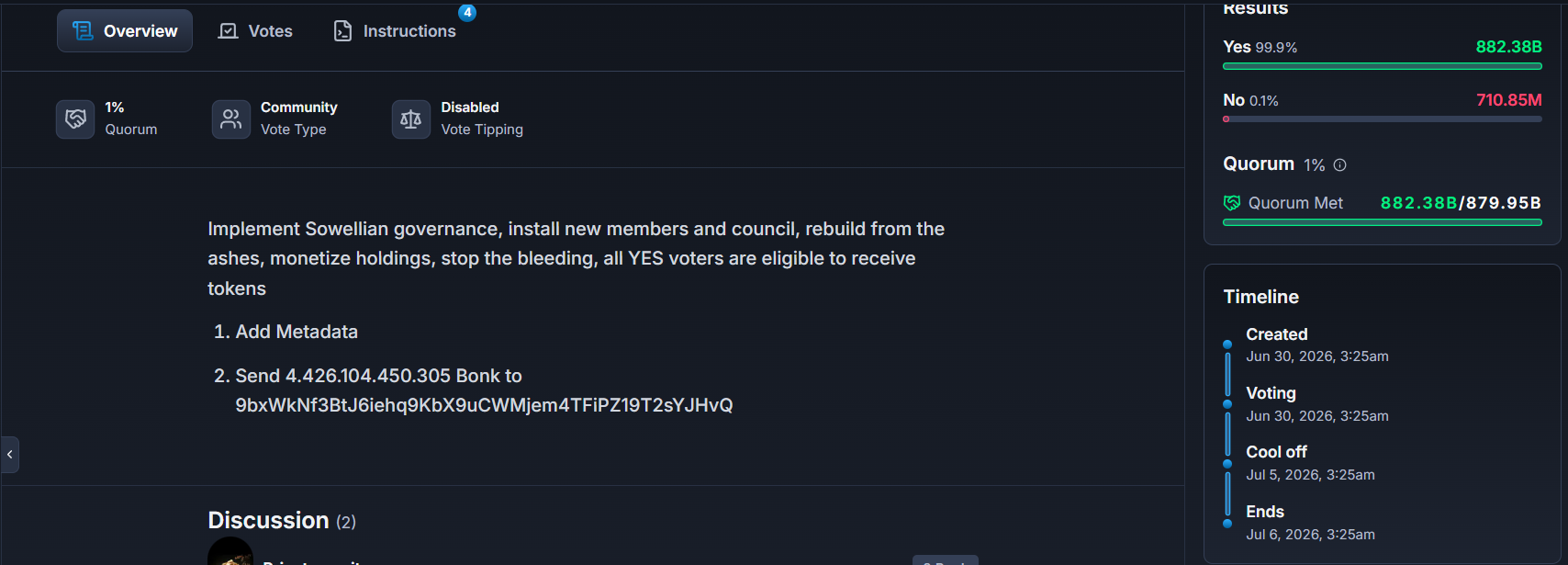](https://v2.realms.today/dao/84pGFuy1Y27ApK67ApethaPvexeDWA66zNV8gm38TVeQ/proposal/6wR1jdhhJ31bbdRNXva8MxqsgsNLKTxargcdAyZ7FcRj) This was not a proposal for discussion, but the embedded meta data will immediately execute the transfer. --- ## How the attack unfolded ### 1. A legitimate-looking proposal carried a treasury instruction The proposal reportedly required only 100 million BONK(<$400) to submit, making it relatively inexpensive to place a binding proposal before the community. Its executable instruction would transfer approximately 4.426 trillion BONK to a wallet controlled by—or associated with the proposal’s creator. ### 2. The attacker accumulated voting power BonkDAO used token-weighted governance: the more BONK a wallet controlled, the more voting power it could exercise. The proposal needed affirmative votes equal to approximately 1% of the governing token supply, or roughly 879.95 billion BONK, to satisfy quorum/Voting thresh hold. Over July 4 and 5, a separate wallet reportedly accumulated around 882.2 billion BONK through purchases on Binance and Bybit, with some reports also pointing to borrowed tokens. The estimated acquisition cost was approximately $4.4 million. The wallet assembled almost exactly the amount needed to control the outcome.[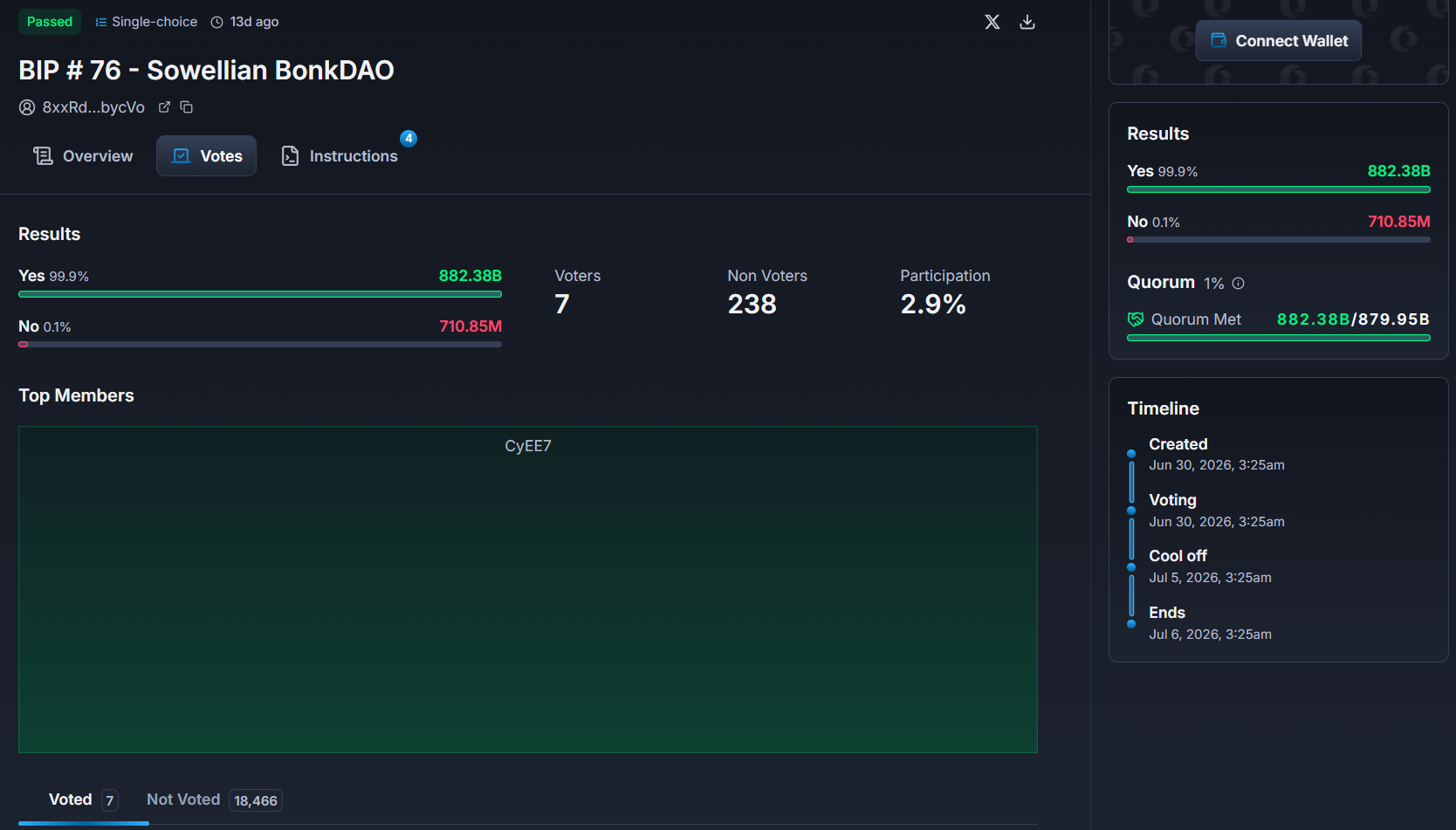](https://v2.realms.today/dao/84pGFuy1Y27ApK67ApethaPvexeDWA66zNV8gm38TVeQ/proposal/6wR1jdhhJ31bbdRNXva8MxqsgsNLKTxargcdAyZ7FcRj/votes) The cost of capturing the governance vote was substantially lower than the value the governance could release. ### 3. Almost nobody showed up to defend the treasury The proposal remained open for approximately six days. Only seven wallets reportedly participated. One large wallet accounted for about 99.87% of the affirmative voting power. The final count was approximately: - 882.38 billion BONK in favor - 710.85 million BONK against - 879.95 billion BONK required for quorum The proposal cleared the threshold by a narrow margin. Its apparent 99.9% support did not represent broad community agreement; it was overwhelmingly the product of one concentrated position. This is one of the most misleading features of token-weighted governance: *a proposal can show near-unanimous approval while attracting very little meaningful participation.* ### 4. The transfer executed with no delay When voting closed on July 6, the proposal passed. BonkDAO’s governance configuration reportedly had an instruction hold-up time of zero seconds. That meant there was: - no waiting period between approval and execution, - no 24-hour community review, - no emergency veto window, - no time to flag the recipient, and - no multisignature wallet to approve the large treasury withdrawal. The approved instruction transferred approximately 4.426 trillion BONK from the treasury in the same transaction sequence. Once the vote passed, nothing remained between the proposal and the money.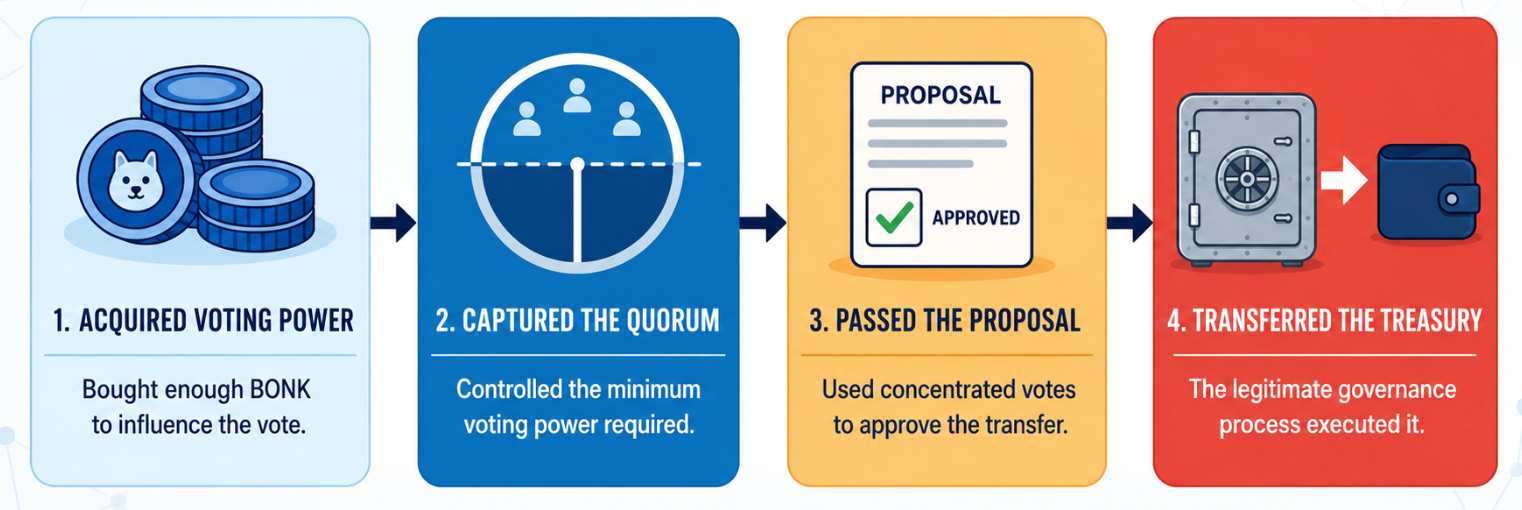 The attacker reportedly began selling the $Bonk used to originally secure the votes. A portion of the funds moved towards an exchange while much of the remainder was transferred to another wallet or attacker-controlled multisignature arrangement. As of July 19, a complete official post-mortem and confirmed recovery accounting had not yet been published. [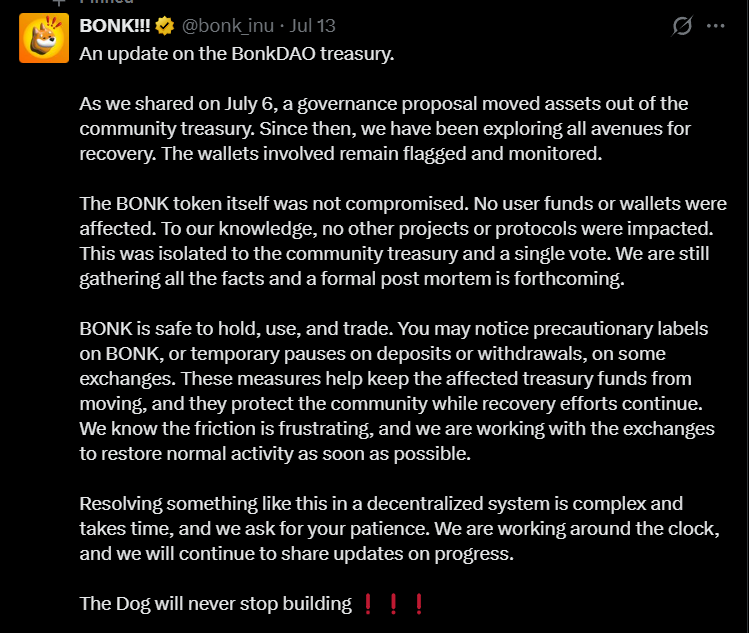](https://x.com/bonk_inu) --- ## Why this is not a hack. The incident needs careful framing especially as we have seen a series of DeFi hacks that are smart contract related. Everything happened just as intended. Here is what was compromised: - The BonkDAO community treasury - The economic security of the governance quorum - The proposal-review process - Confidence in the DAO’s treasury controls - The assumption that token holders would actively monitor governance BonkDAO stated that the incident was confined to the treasury and a single governance proposal. It also said the associated wallets had been flagged and that it was working with exchanges, the Solana Foundation, bridges, and law enforcement. As a result, the following was uncompromised: - The BONK token contract - BONK holders’ private keys - Individual user wallets - The underlying Solana network - Every application integrating BONK That does not mean holders were economically unaffected. Treasury losses can reduce resources for ecosystem development, liquidity programs, grants, marketing, and other initiatives. Stolen tokens can also create sell pressure. The code performed correctly. The security assumptions surrounding the code failed. ### Key Controls That Failed: Low quorum: 1% of supply could authorize a treasury take over. Liquid voting power: An outsider could purchase or borrow enough tokens shortly before a vote. No execution time-lock: The treasury transfer executed immediatly after approval. No secondary authorization: A large withdrawal did not require a separate multisig, council, or guardian approval. Lastly, low voter participation magnified every one of these weaknesses. --- ## Governance is part of the attack surface Security should not end with audited smart contracts and protected private keys. The BonkDAO incident demonstrates why that view is incomplete. A protocol may have correct code and uncompromised wallets while its treasury remains vulnerable through weak decision-making rules. Governance determines who can instruct the contracts, what transactions they can authorize, and how quickly those transactions execute. That makes governance part of the security architecture and not a community feature sitting outside it. The BonkDAO treasury was not reportedly defeated by superior code. It was defeated by an attacker who recognized that the DAO had priced the authority to move approximately $20 million at roughly $4.4 million. They bought the vote that opened the door. Most investors study price, market capitalization, token unlocks, and trading volume. Few investigate whether a project’s treasury can be captured. That needs to change. The most important comparison is not merely treasury size. It is: ***Cost to capture governance versus value accessible through governance.*** When the first number is meaningfully lower than the second, the treasury may be offering an economic bounty to an attacker. Decentralization does not require treating every proposal as equally safe. A safer governance system would layer controls according to financial impact and follow different execution paths.