The Coldcard hack incident even though its a small bitcoin-only wallet provider service, has sent panic and genuine questions are being asked about ***Crypto custody,*** and not just hardware wallets. Here is the 80/20 of two custody models: **Custodial storage,** an exchange or company holds the keys for you. **Self-custody**, you hold them yourself. Within self-custody, a hot wallet keeps keys on an internet-connected device, while cold storage keeps keys off those devices. Coldcard hardware wallets are devices that keep private keys offline and sign transactions without those keys touching the internet-connected machine preparing the transaction. In essence, this is what hardware wallets are designed to do well: *isolate keys, reduce exposure to malware on laptops and phones*, and let users review transaction details on a dedicated device. > The Coldcard incident matters because it challenges one of the most common assumptions in crypto security: *that if a wallet is offline, it is safe by default.* That assumption was always too simple. Cold storage reduces important risks, especially the risk of keys being exposed to malware on an internet-connected phone or laptop. But cold storage is only as strong as the process that creates and protects the keys in the first place. If that process fails, then the wallet can be “cold” and still be compromised. That is what makes the Coldcard hack such an important case study. It is not just about one hardware wallet. It is about *crypto custody, single-device trust,* and the difference between reducing risk and eliminating it. --- ## What cold storage is supposed to do Cold storage is designed to keep signing keys off internet-connected devices. In a normal hardware-wallet setup, the wallet generates and stores the private keys, while the computer or phone prepares the transaction. The key never needs to leave the device. That model still makes sense, and it works. It remains one of the best ways to reduce exposure to common threats like malware, clipboard hijacking, and malicious browser extensions. Standard self-custody practices still matter: - keep seed phrases offline - verify transaction details on the device screen - update firmware carefully - separate devices and backups physically - avoid storing your entire balance behind one point of failure None of that has changed. What this incident appears to show is that cold storage protects against some threats very well, but not all of them equally. It is strong against online compromise. It is not automatically strong against a flaw inside the wallet’s own ***seed-generation path.*** Here some standard security practices when using cold storage: - Seed material should remain offline, not to be photographed, typed into cloud notes, or stored digitally. - Hardware wallet should not be treated as a single all-purpose point of trust. They can become single points of failure through exploits, firmware issues, or manufacturing defects. Multisig and device diversity for holdings is highly recommended. - Physical separation still matters i.e geographically separating hardware wallets and seed backups so that one theft, one fire, or one accident cannot wipe out the whole setup. - Passphrases and multisig remain meaningful layers. They are not magic, but they change the attack surface. They add an independent barrier. - Vendor verification and device provenance as hardware wallets can also be attacked through physical tampering and supply-chain scams. Cold storage is strongest when it is part of a layered security model, not when it is treated as a single silver bullet. --- ## How the attack happened and the Phases Involved On **July 30, 2026**, security researchers published a technical advisory saying it had identified Coldcard *seed-generation vulnerabilities*that allowed theft from users and that exploitation was already active. They warned users that updating firmware alone would not make previously generated seeds safe. Users with affected seeds were told to migrate funds to newly generated wallets created under patched conditions. This was not presented as a routine bug fix. It was treated by outside researchers and the vendor as a live security event involving already-generated seeds. The thefts unfolded in waves. Exact totals vary across outlets, so the scale should be treated carefully. But the broad pattern is consistent: this was not described as a single isolated drain. It was described as repeated sweeps against exposed wallets. The phase-based nature of this incident is the most useful part for education, because each phase exposes a different lesson about custody. ### Phase 1: The vulnerability existed long before the public saw the thefts According to Block’s advisory, the vulnerable seed-generation path dated back to firmware changes introduced in **March 2021**. Hence, multiple device families and firmware ranges were affected before patched versions were released. That means the visible “hack” on July 30, 2026 was not the start of the problem. It was the moment the problem became publicly visible. This is one of the hardest lessons in wallet security: a wallet can be compromised at the moment it is created and still appear normal for months or years. A user can back up the seed correctly, keep the device offline, and follow all the usual operational steps, but if the original entropy was weak, the whole setup may already be unsafe. ### Phase 2: The weakness was reportedly in seed generation, not in the wallet going online This distinction matters. Most people hear “hardware wallet hack” and imagine malware, phishing, or the user being tricked into signing a bad transaction. But the public technical discussion around this incident points instead to a problem in random number generation and entropy. If the seed is predictable or constrained, an attacker may not need the device, the backup card, or the user’s approval. The attacker’s job becomes one of narrowing possibilities and testing them against public wallet data until a match is found. That is a very different kind of failure. It means the issue is not that the wallet stopped being cold. It means the secret at the center of the cold-storage model may not have been strong enough from birth. ### Phase 3: The thefts reportedly unfolded in waves because exposed wallets could be targeted over time Outside reporting described the drains as happening in multiple waves after the vulnerability became actively exploitable. While exact figures differ, the wave pattern itself is important. A bug that existed for years does not have to be exploited immediately. Once attackers understand the weakness and develop a practical way to search for vulnerable wallets, they can move in batches. They may start with the easiest or most obvious targets, refine their methods, then continue sweeping. That is why the phrase “ongoing vulnerability” matters here. The exposure window began when affected seeds were created. The visible attack waves came later.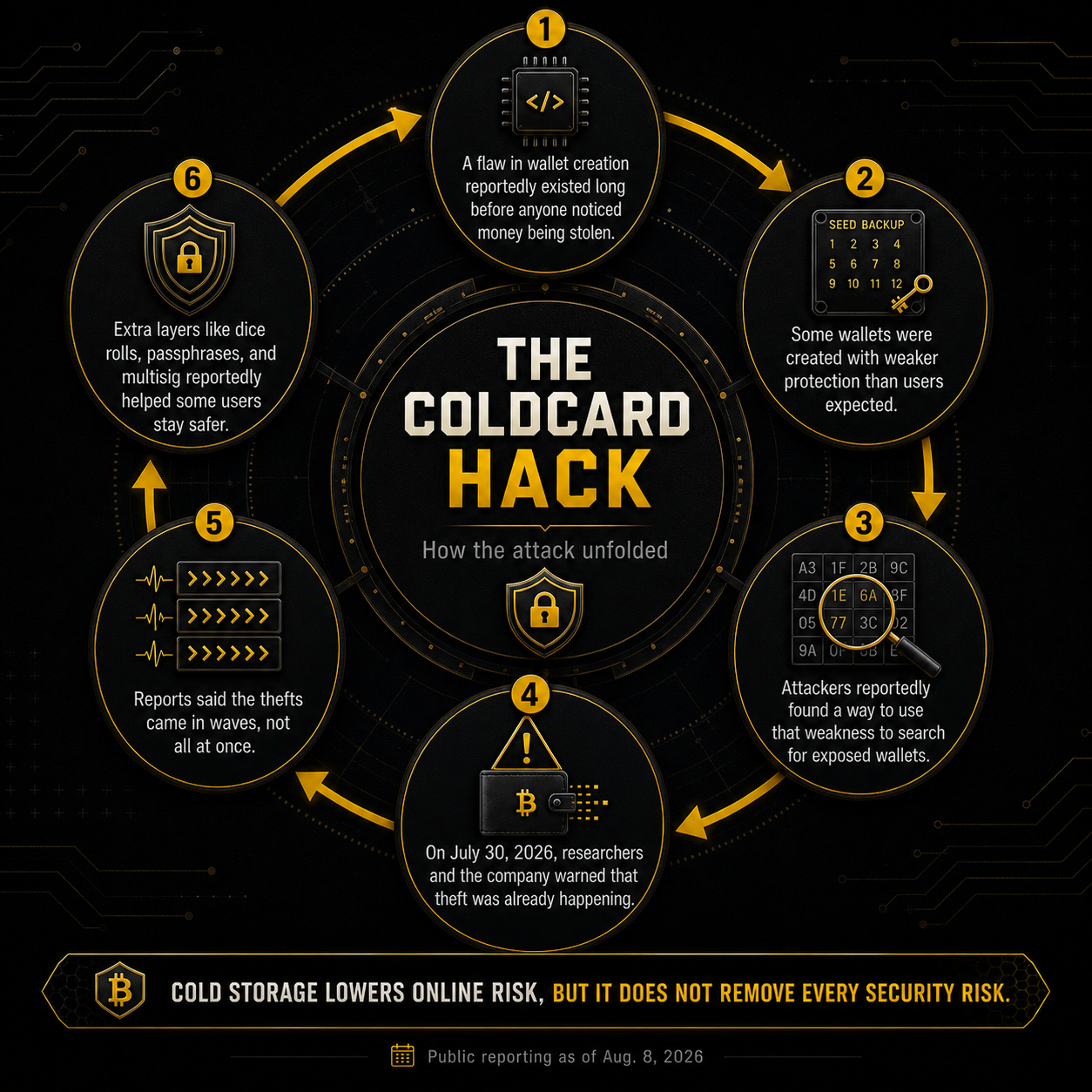 ### Phase 4: Users with extra layers had more room to respond Two mitigating factors were highlighted by researchers. One was the addition of sufficient independent dice entropy during seed creation. The other was the use of a strong, unique BIP-39 passphrase. Multisig also matters here, because one weak signing device does not automatically compromise funds if the remaining quorum is secure. This is a major lesson. Security layers are not pointless just because one layer fails. They are there for exactly this reason. A user who relied entirely on device-generated entropy had less margin for error. A user who added private dice rolls, used a strong passphrase, or held funds in a properly designed multisig setup had more options and more time.[](https://cryptostoicmedia.com/#pricing) --- ## What cold storage still gets right It would be a mistake to assume this incident means cold storage does not work. Cold storage still provides a real security improvement over keeping keys on general-purpose connected devices. The standard practices remain valid: - keep seed phrases offline - do not photograph or cloud-store backups - verify addresses on the wallet screen - buy devices from trusted channels - keep firmware current - separate backups geographically - do not depend on one device for serious holdings Those are still the right habits. The Coldcard incident does not make them obsolete. What it does is show that they are not the whole story. A hardware wallet helps reduce online risk. It does not remove implementation risk, vendor risk, or the possibility that a critical internal assumption can fail. ### Security experts agree: 1. the core problem is in randomness and reseeding. 2. no single wallets should be the core model for meaningful holdings. 3. do not let one device family become a single point of failure. 4. offline backups and physical separation with careful seed handlings. 5. hardware wallets remain security tools, not trust anchors. The bottom line is that this should exist inside a broader security architecture. Across those views, the common message is consistent: ***hardware wallets matter, but layered custody matters more.*** --- ## Is cold storage broken? No. But a simplistic view of cold storage is. Cold storage is still one of the best defenses against malware and remote compromise on everyday devices. What this incident appears to show is that “offline” should never be confused with “beyond failure.” A hardware wallet can still be undermined by weaknesses in seed generation, firmware, manufacturing, or user assumptions aka supply chain compromise. The real failure here was not the idea of cold storage itself. It was the belief that one respected device, by itself, equals complete security. ## What Self-Custody Users Should Learn From the Coldcard Hack The strongest lesson from the Coldcard hack is not that hardware wallets are a bad idea. It is that self-custody should be treated as a ***layered system***, not a product purchase. The Coldcard incident is best understood as a warning against single-device trust. Hardware wallets still matter. Offline key handling still matters. But so do entropy, firmware quality, passphrases, multisig, hardware diversity, and migration discipline. For new users, the lesson is not to abandon self-custody. It is to understand it more clearly. A hardware wallet is a valuable tool, but it is not a complete strategy by itself. If there is one sentence worth carrying forward, it is this: > The Coldcard incident did not prove cold storage is broken. It proved that hardware wallets are security tools and not trust anchors. --- ### Sources: [Block](https://engineering.block.xyz/blog/predictable-rng-fallback-and-32-bit-reseed-in-coldcard-firmware) Engineering advisory, [Coinkite ](https://blog.coinkite.com/coldcard-mk3-seed-generation-warning/)security advisory, [Coldcard](https://coldcard.com/about) hot vs cold explainer, [Casa](https://support.casa.io/knowledge/hardware-devices-and-keyset-diversity) on hardware diversity, [Unchained ](https://help.unchained.com/how-should-i-secure-my-keys-and-seed-phrases)on securing keys and seed phrases, [Kraken Security Labs](https://blog.kraken.com/product/security/alert-modified-hardware-wallets-spotted-in-the-wild) on hardware wallet risk, [Barron’s reporting](https://www.barrons.com/articles/bitcoin-price-security-breach-strategy-stock-75dcdf54), New York Post reporting.