When it comes to financial markets or crime, you hear the saying "*follow the money* - FTM". Numbers do not lie, but can be manipulated to build a certain perception or tell a certain version of the story. But, with public blockchains being *decentralized, transparent and immutable*, you cannot just make up stuff. Data verifiability is possible and this is where crypto lives. As an on-chain crypto analysts, most of what you need is open-source for starters though very different at high levels. With the crypto markets down 50% from its all time high, nothing is more important right now than honing your on-chain skills. Crypto might be less than 2 decades old, but we are still in the early phases of the The World Coming On-chain through **Tokenization** - *bringing real world assets on-chain.* Its for this reason I tell most people, you are not late, but you just have to start right as to end right. This is the framework used in the last bull market to get into **Solana** when it was $20 and **Bitcoin** at $16-20K range(mostly because of experimentations on bitcoin such as *Ordinals, Rune*s and *DeFi *on Bitcoin). > The market is not an ATM. You need to position before narrative confirmations. You do this by building an edge in the illiquid phase of crypto research. --- ## Part 1: The Real Edge Starts Before the Chart Most crypto participants enter after the asset becomes visible. They wait for a breakout, a trending ticker, a KOL mention, a CoinGecko listing, or a centralized exchange announcement. Those signals are useful, but they are usually late-stage visibility signals, not early discovery signals. You do not want your strategy to be based on what is popular. The better question is: **What happened before the market had a clean chart to trade?** That is where the illiquid phase matters. The **illiquid phase** is the period before public price discovery becomes obvious. It includes private fundraising, ecosystem grants, developer migration, token allocation, testnet activity, pre-TGE positioning, early infrastructure buildout, and the first signs of real chain usage. This is not a memecoin framework. This is for projects and ecosystems where the edge comes from understanding: 1. capital formation, 1. builder behavior, and 1. early adoption before narrative confirmation. The goal is not to be an insider. The goal is to read the footprints insiders, funds, builders, contributors, and early ecosystem participants leave behind. 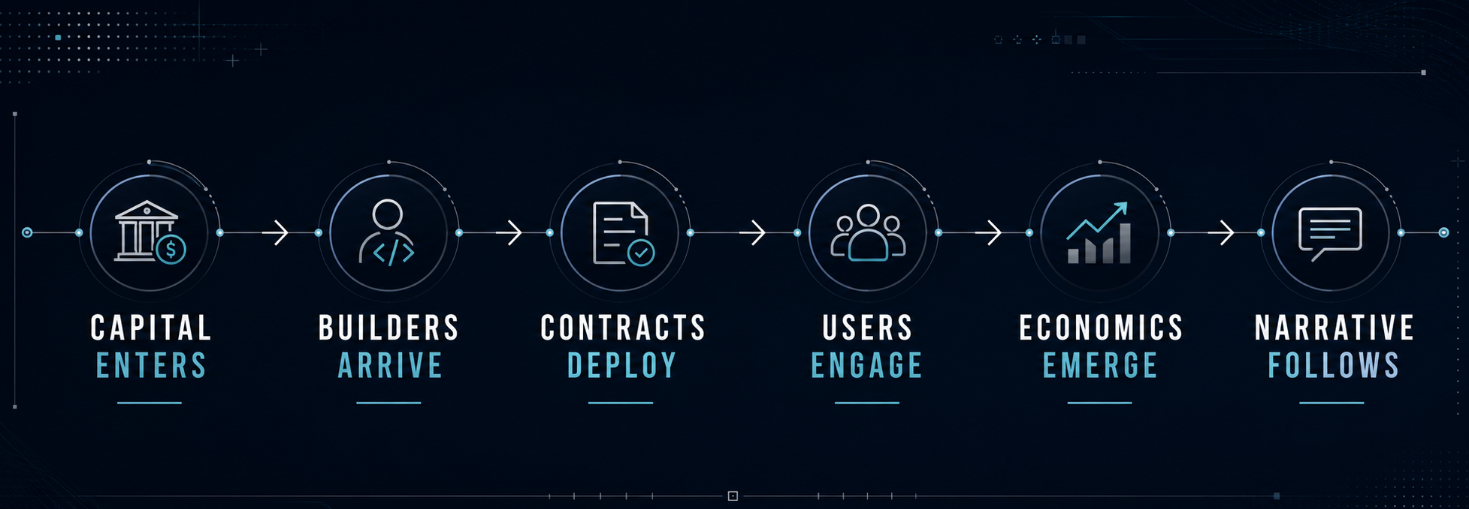 That sequence is where an onchain analyst can build an edge. --- ## Part 2: Follow Funding Liquidity First In the illiquid phase, liquidity does not always mean DEX liquidity. It often means ***funding liquidity.*** Funding liquidity tells you where private capital is flowing before the market has a public price. This is important because crypto narratives are often seeded months before they become visible to retail. A strong funding-flow signal is not simply “this project raised money.” Many projects raise money and still fail. You do not consider a metric in isolation, you build confluence. You want to if credible funds repeatedly allocating to the same sector, infrastructure layer, or ecosystem before public attention arrives? That is how to separate isolated deals from emerging capital clusters. This is not circular accounting, but quality capital from top tier VCs betting alike. It does not mean they are right all the time. Its called "Venture Capital" for a reason. We have FTX and Terra Luna to tell us even VCs can be blind-sided when it comes to due diligence. ### Some Crypto-Native sites to Monitor Funding [CryptoRank](https://cryptorank.io/funding-rounds) Useful for tracking recent crypto VC investments and broader fundraising trends, including funding by category, round type, and investment size.  [DeFiLlamma](https://defillama.com/raises) Useful as a fast-flow tracker for funding rounds, investor activity, funding amounts, and protocol categories.  [RootData](https://www.rootdata.com/fundraising) Useful because it is built around crypto-native entity mapping: projects, people, investors, and fundraising events.  [Crypto-Fundraising](https://crypto-fundraising.info/) Useful for validating recent funding announcements, investor names, dates, categories, and amounts. It tracks rounds from pre-seed to Series C with project and investor profiles. [](https://crypto-fundraising.info/) > The goal is not to use 10,000 different tools, but a few tools in 10,000 different ways. You move from discovery to verifiability to validation.  A weak analyst sees a raise and assumes upside. A stronger analyst asks: *Who funded it, why now, what sector is clustering, and how might that capital become developer activity or future token supply?* --- ## Part 3: Track Whether Capital Attracts Builders Funding alone is not enough. Capital should attract builders. If a sector receives funding but developers do not show up, the narrative may be financial engineering rather than real ecosystem formation. This is where developer metrics become the second layer of the illiquid-phase edge. Developer activity helps answer: ***Is the ecosystem being built before the market notices?*** ### Sites To Monitor Developer Activities. [Electric Capital Developer Report](https://www.developerreport.com/). It describes itself as a free analysis of open-source crypto contributions and says it analyzes over 100 million open-source code commits. It provides datasets such as monthly active developers, tenure segments, contribution patterns, and geography, using the same metrics from OpenDevData. [](https://www.developerreport.com/) It identifies which ecosystems are gaining developer mindshare before the token/narrative trade becomes obvious. [TokenTerminal](https://tokenterminal.com/explorer/metrics/active-developers) Provides Protocol-level core developer activity with fundamentals. It defines “core developers” as unique GitHub contributors who made at least one commit to a project’s public repositories over the past 30 days. [](https://tokenterminal.com/explorer/metrics/active-developers) Best for comparing whether a project has real engineering activity relative to fees, users, transactions, and revenue. [GitHub](https://github.com/) - Direct Review You can always go old-school for manual repo verification: commits, contributors, releases, issues, pull requests. Dashboards are useful, but you still want to inspect: - Are commits meaningful or cosmetic? - Are there multiple real contributors? - Are pull requests being reviewed? - Are issues being closed? - Are releases shipping? - Are repos active or abandoned? It avoids false positives from projects that show surface-level activity but little real engineering progress. The key is not raw commit count. A project can create a lot of GitHub noise without shipping anything meaningful.  What you want to look for is: *more contributors, more active repos, more shipped contracts, and more user-facing products.* --- ## Part 4: Confirm Builder Activity With Chain Growth Developer activity should eventually appear onchain. This is where the research moves from “builders are working” to “users are interacting with what builders have deployed.” You have to watch for sybil-like activities, because at the end of the day, its all about ***user retention.*** For illiquid-phase research, this matters because the market may not yet have a clean liquid token to price, but the chain can already show signs of growth.  This is the clean growth sequence: ***Developers arrive → contracts get deployed → users interact → transactions become meaningful → fees prove demand.*** ### They following are worth nothing: A rising developer count with no contract deployment is incomplete. Contract deployment with no active addresses is incomplete. Active addresses with low-quality transactions may be misleading. Transaction growth without fees may indicate cheap activity, spam, or incentive farming. Fees and revenue are stronger because they show economic demand. They are not perfect, but they are harder to fake than raw transaction count. ### Some Useful sites for On-chain Metrics [Block Explorers](https://www.blockchain.com/explorer) These are native to each chain e.g etherscan, solscan, basescan for ethereum, solana and base blockchains respectively. You can verify contract deployments, deployer wallets, transaction patterns, and address behavior manually.  Dune Analytics Build custom dashboards for specific ecosystems, contracts, wallets, or protocols [](https://dune.com/entropy_advisors/morpho-liquidity) ***TokenTerminal*** and ***DeFiLlama*** mentioned above also offer on-chain metrics hence validating the point: its about knowing how to use one tool in 10,000 different ways. The question you need to answer is simple: The dashboard question is simple: ***Is developer activity converting into measurable chain usage before the public narrative forms?*** That is the bridge between early research and market opportunity. --- ## Part 5: Map Supply Before the Public Becomes Exit Liquidity The final illiquid-phase layer is token supply. This is where many traders get caught. A project can have strong funding, strong builders, and growing chain metrics, but still become a poor public-market entry if the *token distribution* is dangerous i.e insiders getting a majority of the allocation ready to dump on retail when it goes public. You should be able to ask and understand the following questions: ### Who owns the supply? *Identifies insiders, investors, team, treasury, community, and ecosystem allocations.* ### When do tokens unlock? *Reveals future sell pressure.* ### How much float exists at launch? *Low float can create misleading price strength.* ### What is the FDV relative to traction? *High FDV with weak usage can create poor risk/reward.* ### Are investors locked or liquid? *Determines whether early buyers may become future sellers.* ### Are ecosystem incentives sustainable? *Incentives can bootstrap growth or distort usage.* ### Crypto-native sites to monitor [CryptoRank](https://cryptorank.io/token-unlock) The token unlock page tracks locked and unlocked tokens, nearest unlock size, unlock dates, and allocation structures. It also defines allocation as the distribution of tokens among groups such as team, investors, and stakeholders. [](https://cryptorank.io/token-unlock) [Tokenomist](https://tokenomist.ai/?sort-key=upcomingEvent.dateUnix&sort-direction=asc&page-size=25&watchlist=false) It tracks token unlocks and explains that vesting releases tokens over time to recipients such as team members and investors. [](https://tokenomist.ai/?sort-key=upcomingEvent.dateUnix&sort-direction=asc&page-size=25&watchlist=false) [DropsTabs](https://dropstab.com/vesting) The vesting page tracks unlock progress, circulating supply changes, unlock sizes, and next unlock dates across crypto projects. [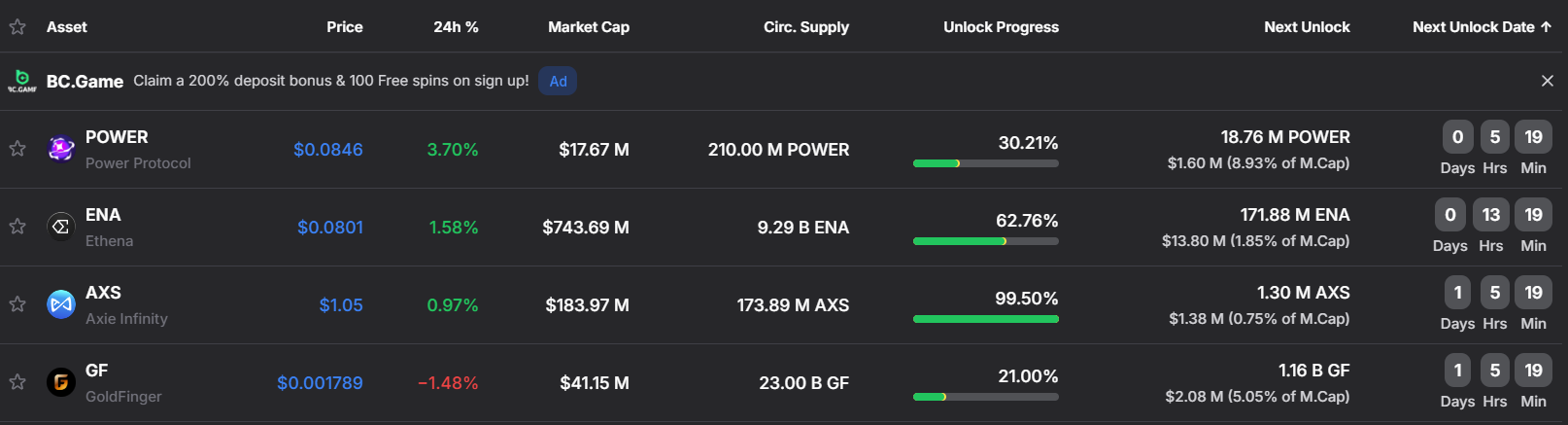](https://dropstab.com/vesting) Project Docs/Tokenomics pages. Found on project website and should be treated as the primary-source validation of allocations and vesting. This step protects the analyst from confusing a good project with a good entry. A good project can still be a bad entry if: - the float is too low, - the FDV is too high, - the next unlock is too large, - private investors are close to liquidity, - or public buyers are entering after earlier players already secured better terms. The cleanest edge is not just finding what is early. It is finding what is early and not structurally designed to make the public the last buyer. > Funding is flowing, builders are active, chain metrics are improving, token supply is manageable, and the public narrative is still quiet. That is how you build an edge before narrative. [Join](https://cryptostoicmedia.com/#pricing)those who have decided to escape the hype and be part of a community that prioritizes process and safety. [](https://cryptostoicmedia.com/#pricing) --- ## Risk in the Illiquid Research Phase Crypto is an asymmetric asset class meaning you can invest in crypto without affecting your life style. Most projects go to zero, but all you need is a little investment in your high conviction bets. The Illiquid-research phase can help you build an edge before narrative confirmation, but it is also the stage where risk is highest. Funding rounds, developer activity, chain metrics, and early token signals can look promising, but they may still be ***incomplete, inflated, or misleading***. - A project can raise money and still have poor tokenomics. - Developers can appear active while shipping little real value. - Active addresses and transactions can be driven by incentives, bots, or Sybil farming. - The biggest risk is mistaking early signals for confirmed truth. - To manage this, every project should pass a simple risk filter before it becomes a serious opportunity: verify the funding and investor data, - map the token supply and unlock schedule, - confirm that developer activity is real, - check whether users and transactions are meaningful, and - make sure the narrative has not already become crowded. - Position sizing should remain conservative until multiple signals align. In this phase, the goal is not to predict perfectly; it is to identify promising early patterns while constantly asking: ***What can make this signal fake, temporary, or dangerous?*** The key question of it all is: ***Who is the next marginal buyer after me?***