One of the most dangerous people in crypto is the person pretending to help you. They intend to bait you, gain your trust, collect your funds, and disappear or keep you as a mark for a recovery scam. You have to understand that organized scam rings recycle victims and pass on their information for another unit to follow up and carry on a different scam. That sounds harsh, but beginners need to understand it early. Many crypto scams do not begin with an obvious threat. They begin with a helpful message. Maybe you posted a question in a community group. Maybe a transaction looks stuck. Maybe your wallet is showing an error. Maybe you clicked a link and now feel unsure. Maybe you searched for support and found an account that looked official. This is no different from someone publicly saying,* “I have money and do not know what to invest in.” Someone, please, tell me what to invest in."* Then someone replies: “We can help.” That is where the risk begins. Fake crypto support scams work because beginners are often confused, nervous, and looking for quick guidance. The scammer does not need to hack your wallet. You already positioned yourself as a target. They only need to convince you to give them access. And the fastest way to do that is by pretending to be supportive. **How Fake Crypto Support Usually Starts** Fake support scams often begin as normal day-to-day actions carried out in normal places. You might see them in:* Direct messages, Telegram groups, Discord servers, X replies, Search results, Comment sections, Fake help desks, , Impersonator emails, “Recovery expert” accounts etc.* The scammer may claim to represent a wallet provider, exchange, project team, blockchain explorer, NFT marketplace, DeFi protocol, or recovery service. They may use official logos, professional language, and urgent warnings. Some accounts are designed to look almost identical to real support accounts. The first message may sound harmless: *- “Kindly DM us for support.” - “We noticed your issue. We can resolve it.” - “Your wallet needs to be validated.” - “Your transaction is pending because your wallet is not synced.” - “You need to restore your account before funds are lost.”* The wording changes. The goal is the same, and so is the behavioral trigger. They want to move you from confusion into compliance by taking an action that seems harmless or normal. **Why Newbies Pose as Easy Targets** Normies are not targeted because they are careless. They are targeted because crypto asks them to make high-consequence decisions prior to learning the risks. As innovative and exciting as the space is, never forget that you are solely responsible for all your actions, and be ready to live with the consequences. This should already tell you there is a learning curve, that if you do not invest in it, then you will fall prey to some nefarious actor down the line. A newbie may not know the difference between a* wallet address, private key, seed phrase, signature, approval, network, bridge, transaction hash, or recovery phrase. * That confusion creates openings. Fake support scammers use technical-sounding words to make their instructions feel legitimate. They may say your wallet must be:* verified, validated, synced, restored, reconnected, migrated, secured, updated, rectified, authenticated etc.* These words are not proof of legitimacy. In many scams, they are just pressure words designed to make you follow instructions without understanding them. The danger is not only what the scammer says. ***It is what they ask you to do next***. Just to be clear, even experienced users get scammed, as detailed in this [article](https://www.kerberus.com/learn/psychology-of-crypto-scams/) 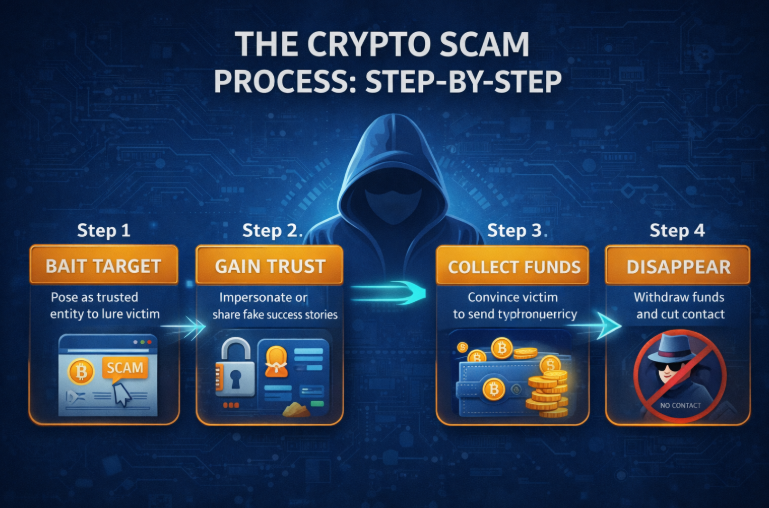 ***The No-Go Zone: Seed Phrase Requests*** Your seed phrase is neither a support nor a verification code. It is not a normal password. Your seed phrase is the recovery key to your wallet. Anyone with access owns your wallet. If someone gets it, they may be able to restore your wallet on another device and move your funds. Once funds are moved, there may be no simple way to reverse the transaction. This is where you have to watch out for so-called “recovery experts”. You can see this in the movie [Self-Custody on Prime.](https://bitcoinmagazine.com/culture/film-review-self-custody-indie-film-about-bitcoin-on-amazon-prime) That is why this rule must be absolute: ****No legitimate support person needs your seed phrase.**** Not a wallet company. Not an exchange employee. Not a moderator. Not a project team member. Not a recovery expert. Not someone who says they are from security. Not someone who claims they need to “validate” your wallet. Fake support may ask for your seed phrase directly, or they may send you to a website that asks you to enter it. Both are dangerous. Never type your seed phrase into a website because someone sent you a link. Never send it in a message. Never read it out loud on a call. Never upload a screenshot of it. Never store it in a place where someone else can access it. If a support interaction asks for your seed phrase, the interaction is over. Close it. Do not negotiate. **Other Things Fake Support May Ask For** Asking for your seed phrase is the endgame. It is not the only thing that may be asked of you. Fake support may also ask you to: - Share your screen - Install remote access software - Send wallet screenshots - Click a verification link - Connect your wallet to a support portal - Sign a message you do not understand - Approve token access - Send a small “activation” or “recovery” fee - Move funds to a “safe” wallet they provide - Share two-factor authentication codes - Download a fake wallet update Each request may be framed as necessary. They always provide legitimate reasons, such a*s helping you protect your funds, preventing your account from being blocked, completing the process immediately, etc*. That is not how safety works. Real help should create a true sense of calm by handing full control over to you. Unsure whether a support message is real? Learn to catch red flags by Getting our [Safety Kit](https://cryptostoicmedia.com/). [](https://cryptostoicmedia.com/) **What Legitimate Support Should Not Do** Support may be able to explain a feature, point you to official documentation, help you understand an error message, or tell you where to find a transaction record. But legitimate support should not require access to your wallet recovery information. Be cautious if any support account asks you to: - *Reveal your seed phrase - Reveal your private key - Share your screen to show wallet details - Install remote-control software - Send funds to unlock support - Connect your wallet through a random link - Keep the conversation secret - Act immediately to prevent loss* The more control they request, the more dangerous the interaction becomes. Support should help you understand. It should not ask you to surrender control. ** The Fake Recovery Trap** Fake support scams often appear after something has already gone wrong. Maybe you sent funds to the wrong place. Maybe you clicked a suspicious link. Maybe a transaction failed. Maybe you interacted with a scam. Maybe assets are missing. That moment is emotionally dangerous, and you are most susceptible. You may feel panic, embarrassment, or urgency. You may be willing to trust anyone who promises a solution. Scammers know this. That is why fake recovery accounts are common. They may claim they can retrieve stolen funds, reverse blockchain transactions, trace the scammer, hack the wallet, or force the funds back. Some may ask for a fee. Others may ask for wallet access. Some may ask you to connect to a recovery portal. Others may use fake screenshots, fake case numbers, or fake testimonials. The result is often a second loss after the first one. **After a loss, slow down, as panicking makes you easier to manipulate.** **How To Get Real Help** If you need help, use a safer process. Start from the official website or app. Do not use links from direct messages, random comments, sponsored ads, or unofficial groups. Check the domain carefully. Look for official documentation. Search for known warnings. Ask in public community channels without sharing private information. Always tag the team or group leader on any response you find suspicious. When asking for help, never post: Seed phrase - Private key - Full screenshots with sensitive details - Authentication codes - Personal account information - Recovery words It is usually safe to share a public transaction hash when appropriate, but even then, be careful about what additional information you reveal. Most importantly, do not let someone pressure you into a private action you do not understand. Real safety gives you time to think. ***Anyone can claim to be supportive. Their request reveals their intent. Pay attention to what action is required of you.*** If they ask for your seed phrase, they are not helping. If they ask for your private key, they are not helping. If they ask for remote access, secrecy, urgent action, or a wallet connection through an unverified link, slow down. Crypto support scams persist because they exploit confusion at exactly the moment beginners are looking for help. Do not measure support by how official it looks. Judge it by what it asks you to give up. Real help should make you safer. It should not require you to surrender control of your wallet. Need help acting safely without handing over control? [Member Guides](https://cryptostoicmedia.com/signup?plan=monthly) walk you through safer first actions step by step — including wallet setup, test transactions, exchange withdrawal checks, and wallet approval review. [](https://cryptostoicmedia.com/#pricing)