*How USDT, USDC, Open USD and tokenized deposits are dividing the market along regulatory, institutional and user-demand lines.* The stablecoin market, now sitting at roughly $300–315 billion in total supply, is not developing into a single, globally uniform payment system. It is segmenting according to what users need, which institutions they trust and how much regulatory oversight a jurisdiction imposes. **Key Points** - In many Global South markets, stablecoins function primarily as accessible digital dollars: a hedge against currency depreciation, a cross-border settlement instrument and, sometimes, a workaround for limited banking access or capital controls. - In the Global North and regulated financial centers, stablecoins are increasingly being integrated into licensed payment companies, banks, enterprise treasury systems and institutional capital markets. - USDT currently possesses the strongest distribution and liquidity moat, especially across crypto trading and emerging-market dollar networks. - USDC is better positioned for compliance-sensitive payments, institutional settlement and regulated on-chain finance. - Open USD is an emerging distribution-led challenger, but it was only announced in June 2026 and is not yet an established payment network. - Tokenized deposits may become the preferred form of on-chain money inside banks, but they are not universal substitutes for stablecoins. The likely outcome is coexistence, not one winner. Different forms of digital money will dominate different trust environments. --- ## 1. One technology, two fundamentally different demands The Global North–Global South distinction should not be treated as a rigid geographic boundary. Singapore, Hong Kong and the United Arab Emirates are highly regulated financial centers, while informal crypto markets also operate inside the United States and Europe. Likewise, USDC is used in emerging economies, and USDT is extensively traded in developed markets. The segmentation is not just regulatory divergence, but the ***type of demand.*** **Open-access dollar demand** is strongest where users face inflation, depreciating currencies, expensive remittances, capital restrictions or limited access to dollar bank accounts. In these markets, the primary question is often: *Can I obtain and transfer dollars reliably?* **Regulated settlement demand** comes from banks, payment providers, fintech platforms and corporations that need clear legal claims, reserve standards, transaction monitoring, accounting integration and identifiable counterparties. Their question is: *Can we use this instrument without creating unacceptable regulatory, liquidity or reputational risk?* The first market prioritizes *availability, liquidity and low-cost transfer*. The second prioritizes *legal certainty, compliance controls and integration* with regulated financial infrastructure. That distinction explains much of the divergence between USDT and USDC. --- ## 2. USDT: the distribution leader for open-access dollars As of July 2026, USDT had approximately $184 billion in circulation and represented about 59% of the stablecoin market. USDC followed at approximately $73 billion. Together, the two instruments accounted for more than four-fifths of stablecoin supply. [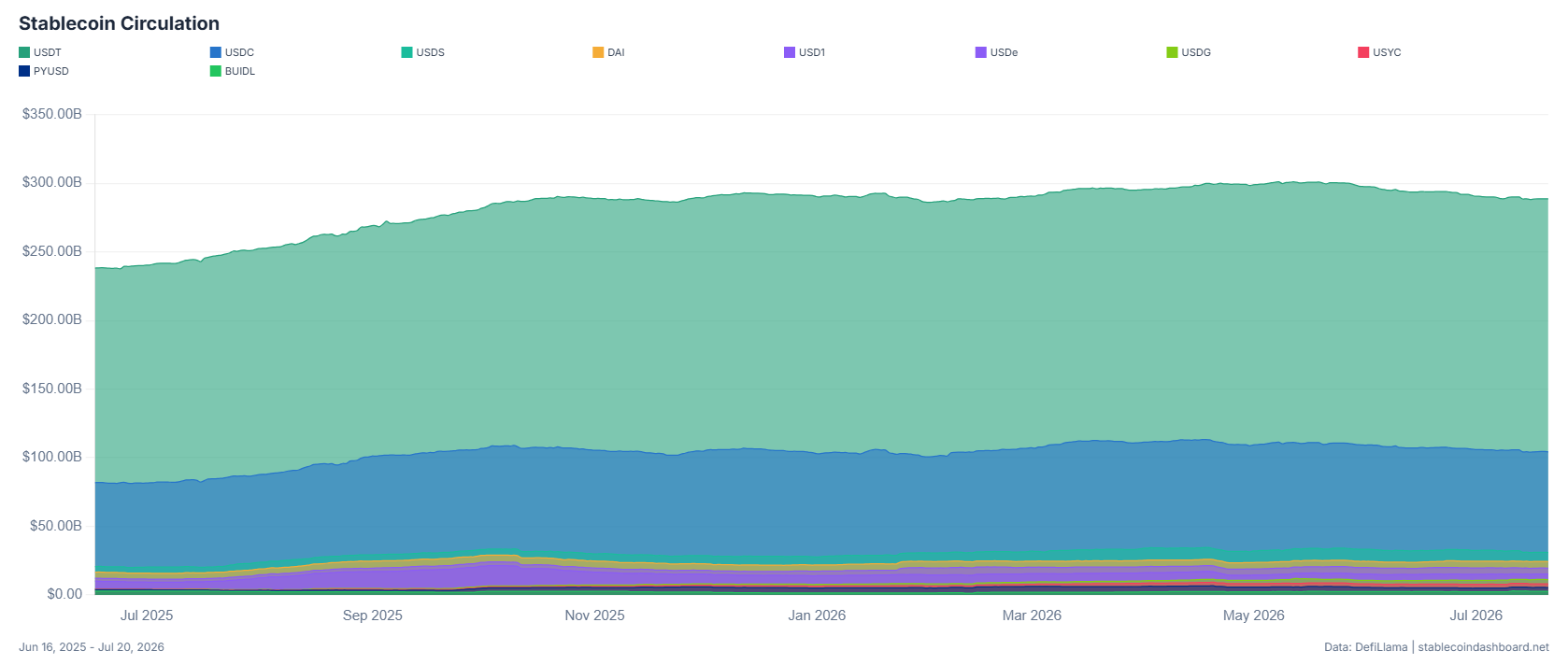](https://stablecoindashboard.net/) USDT’s moat is not simply its size. It is the network built around it: - Deep liquidity across centralized exchanges - Extensive wallet and over-the-counter availability - High adoption on low-cost networks such as TRON - Established use among traders, remittance intermediaries and cross-border merchants - Strong user habits in markets where access matters more than regulatory classification The demand is visible across emerging markets. Latin American crypto adoption increased by 63% and Sub-Saharan African adoption rose 52% in its 2025 measurement period. Sub-Saharan Africa received more than $205 billion in on-chain value between July 2024 and June 2025. All this volume was/is being driven by remittances, commerce and everyday financial activities, not speculation alone as reported by [Chainalysis Regional Report.](https://www.chainalysis.com/blog/subsaharan-africa-crypto-adoption-2025/) Stablecoin use in cross-border transactions tends to increase following periods of high inflation and foreign-exchange volatility. Some view it as a double-edged instrument: they can expand access to dollar savings and cheaper payments, but also facilitate capital flight, currency substitution and the circumvention of domestic controls. It will be misleading to think USDT as the rogue stablecoin used in sanction evasions, unlicensed money transmission and opaque trade settlement. In collaboration with authorities, [Tether](https://tether.io/news/tether-supports-freeze-of-more-than-344-million-in-usdt-in-coordination-with-ofac-and-u-s-law-enforcement/) announces wallet freezes due to suspicious activities, and such freezes are verifiable. Tethers tokens are fully backed and publishes daily circulation figures and quarterly reserve reports that can be verified [here.](https://tether.to/en/transparency/?tab=usdt) Tether chose not to seek MiCA authorization, arguing that concentrating reserves in commercial banks introduces the same credit and maturity-mismatch risk that surfaced in the collapse of Silicon Valley Bank. MiCA states that Issuers of "e-money tokens" must hold at least 60% of reserves as deposits in EU-supervised banks and obtain formal authorization before licensed platforms can offer them to retail users. Major EU-regulated exchanges already delisted or restricted USDT trading pairs, but still very popular within self-custody wallets. --- ## 3. USDC: compliance as a distribution strategy USDC competes on a different combination of attributes: regulated issuance, reserve transparency, direct institutional access and integration with compliance-sensitive financial platforms. This structure creates higher operating costs. Institutional onboarding requires legal review, sanctions controls, KYC and KYB processes, transaction monitoring, regulatory reporting, banking relationships and jurisdiction-specific market access. Those costs should not be interpreted simply as organizational inefficiency. They purchase something valuable: *access to counterparties that cannot responsibly interact with less-defined regulatory structures.* Circle publishes reserve information and monthly assurance reports and positions USDC as redeemable one-for-one through regulated affiliates.[](https://www.circle.com/transparency) USDC is therefore especially well positioned for: - Enterprise payments and treasury settlement - Regulated exchanges and custodians - On-chain capital markets and tokenized assets - Fintech payment products - Institutional DeFi participation - Cross-border payment providers requiring auditable fund flows A regulated fintech may use USDC to settle payments into Africa or Latin America while converting to local currency at the final mile. The front-end user may never know that USDC served as the settlement asset. The practical distinction is that USDT often spreads through user/merchant-led adoption, while USDC increasingly spreads through institution-led integration. --- ## 4. Open USD: a potential challenge to the issuer-centric model USDT and USDC have a combined market share of approximately 83%, and for the first time might be facing a real threat if it succeeds. One thing that has been difficult to replicate in the stablecoin business is *distribution.* Most stablecoins do not fail, but due to lack of distribution tend to have low liquidity, hence not very attractive. Hence, Open USD, or OUSD, must be treated separately from established stablecoins. Announced by [Open Standard](https://joinopenstandard.com/blog/introducing-open-usd) in June 2026, it is expected to launch later in 2026. It is therefore an emerging proposition, not yet a proven competitor with established circulation, liquidity or redemption performance. For the first time we are seeing the convergence of TradFi, Big Tech, and Crypto native ecosystems taking a shot at the established players. Combined, these are multi-trillion dollar industries with already built-in distribution channels ready to be plugged in. Open USD proposes to share more of the stablecoin’s economics and governance with the companies distributing and integrating it. Traditional stablecoin issuers earn income from the reserve assets backing their tokens. Distributors may deliver wallets, users and transaction volume without participating proportionately in that reserve income. Open USD attempts to turn this relationship into shared infrastructure amongst it 150 proposed potential partners. Its not clear what the role of each of these partners will be, but the heavy lifting will fall more on Stripe and Bridge. If successfully launched, it may appeal to: - Neobanks - Payment processors - Wallet providers - Enterprise software platforms - Internet marketplaces - Companies that want embedded digital-dollar settlement without surrendering all the economics to an external issuer Open USD could therefore compete more directly with USDC for enterprise distribution than with USDT for informal, retail-led dollar access. But consortium backing does not automatically create premium trust. Stakeholders still need answers about the regulated issuer, bankruptcy remoteness, reserve custodian, redemption rights, AML responsibilities, chain support, liquidity and governance during stress. Until those mechanisms are operational and tested, Open USD remains infrastructure with potential, not established monetary infrastructure. --- ## 5. Tokenized deposits: banks bring commercial money on-chain A tokenized deposit represents a claim on a specific commercial bank. It keeps customer funds inside the insured, KYC/AML-supervised banking system while offering 24/7 atomic settlements. 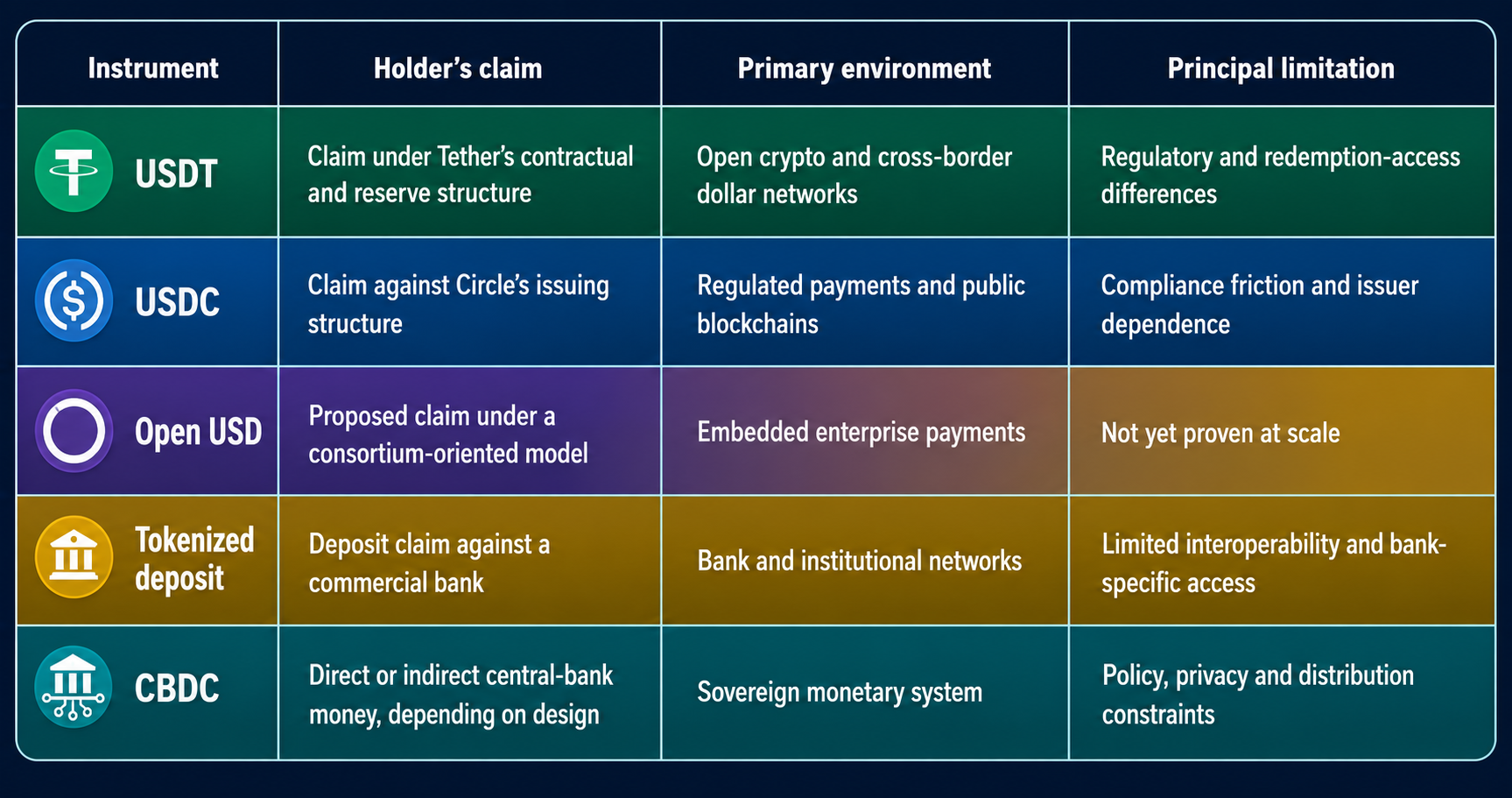 JPMorgan’s JPM Coin is described as a one-for-one bank-backed deposit token for institutional clients, allowing around-the-clock settlement. Its JPMD deposit token also extends bank money onto a public Ethereum Layer 2 while remaining permissioned. Citi Token Services similarly enables corporate and institutional clients to transfer liquidity between participating Citi branches continuously, while its trade product uses programmable tokenized deposits. Tokenized deposits have clear advantages inside regulated banking: - Existing KYC and deposit relationships - Integration with treasury and cash-management systems - Bank-grade controls and legal documentation - Potential compatibility with credit creation and monetary-policy transmission - No need for a corporation to hold a separate non-bank stablecoin A JPMorgan token and a Citi token are not automatically interchangeable. Nor can every merchant, consumer or wallet access them. Unless banks develop interoperability and shared settlement standards, tokenized deposits may reproduce the fragmentation of correspondent banking on faster infrastructure. Banks already have a shared network on Zelle and already piloting [ZLUSD](https://www.zelle.com/press-releases/zelle-heads-to-india-unveils-zelleusdsm-stablecoin-other-markets) with its first target market being India. This could be a potential unifying rail for tokenized deposits among these member banks. Banks argue that stablecoins do not fully satisfy the monetary-system requirements of singleness, elasticity and integrity. --- ## 6. Regulation will redirect adoption, not eliminate it. Regulatory frameworks are already reshaping distribution. The European Union’s MiCA regime requires authorization for issuers of asset-referenced and e-money tokens and imposes rules covering *reserves, custody, governance and redemption*. Hong Kong has required issuers of fiat-referenced stablecoins to obtain a license since August 1, 2025. These rules create defensible markets for compliant issuers, banks and payment platforms. They also increase the likelihood that non-compliant activity migrates offshore, becomes peer-to-peer or continues through platforms outside the regulator’s effective reach. For compliance teams, “regulated stablecoin” must not become a substitute for transaction-level risk assessment. Even a fully reserved, licensed token can pass through: - Sanctioned or high-risk addresses - Unlicensed exchanges - Fraud proceeds - High-risk bridges and mixers - Jurisdictions with weak AML enforcement - Agents concealing the true originator or beneficiary [](https://cryptostoicmedia.com/) Conversely, the use of USDT should not automatically be treated as criminal or illegitimate. Risk depends on the parties, jurisdiction, transaction purpose, source of funds, redemption path and controls surrounding the payment. --- ## Segmentation by trust architecture. The stablecoin market will likely divide into several overlapping systems: **USDT**: open-access dollar liquidity and crypto-market settlement **USDC**: regulated public-blockchain money for institutions, fintechs and onchain finance **Open USD**: potentially distributor-owned infrastructure for embedded enterprise payments **Tokenized deposits**: programmable commercial-bank money for institutional treasury and settlement **CBDCs:** sovereign settlement and policy infrastructure where governments choose to deploy them The central divide is not simply Global North versus Global South. It is between open networks optimized for accessibility and regulated networks optimized for institutional accountability. For stakeholders, the correct question is therefore not, *Which digital dollar will win?* It is: > Which form of onchain money matches the user’s need, the institution’s legal obligations, the jurisdiction’s rules and the transaction’s risk profile? Stablecoin adoption will continue because the underlying demands; *dollar access, faster settlement, continuous liquidity and programmable payments* are real. Regulation will determine which institutions can serve those demands openly. It will not make the demands disappear.