## The 4 Levels of AI: Why Most People Are Still Stuck at Level 1 It feels like a very long time since the launch of ChatGPT(Chatty G) and all the excitement of the capabilities. While advancement is moving at unprecedented speed, the output we get from using these LLMs is a far cry from its intended potential. The litmus test: If you think there is a limit aside from cost, then you are probably not using it right. Research shows its more of a skill issue that the LLMs themselves. Artificial intelligence is no longer just a tool for answering questions. It is rapidly becoming a system for getting work done. While that shift may sound subtle, it fundamentally changes how individuals, teams, and organizations should think about productivity, decision-making, and execution. Today, most people still interact with AI like a smarter search engine. They ask a question, receive an answer, copy the output, and move on. While that approach is useful, it represents only the first stage of AI adoption. The real opportunity lies in moving beyond prompts and toward systems where AI can plan, execute, evaluate, and improve work with increasing levels of autonomy. This transition is already underway. We are moving from prompts to agents, from agents to workflows, and from workflows to autonomous loops. - A prompt is a single instruction. - An agent is a system capable of taking action. - A workflow is a sequence of connected tasks. - A loop is a continuous cycle where AI observes, decides, acts, evaluates outcomes, and adjusts until a goal is achieved. Understanding these distinctions is becoming one of the most important skills of the AI era. Off course, not everyone needs to go beyond harnessing more can be done with agents than just prompting. The easiest way to understand this evolution is through four levels of AI autonomy. --- ### Level 1: Prompting (Ask AI) This is where nearly everyone starts, and its very okay. Unfortunately its where most still are. AI enabled browsers have only re-enforced this idea of using LLMs as search engines. You open ChatGPT, Claude, Gemini, or another AI tool and ask it to help with something. It might summarize a report, draft an email, explain a concept, generate ideas, or write a social media post. At this stage, the human remains fully in control. You decide what to ask, evaluate the response, and determine what happens next. AI functions as a ***responsive assistant*** rather than an independent contributor. There is tremendous value in this level. A well-crafted prompt can save time, reduce cognitive load, and accelerate learning. For many professionals, this is the first moment they realize AI can significantly improve productivity. However, Level 1 has a limitation. ***Every output depends on another human instruction.*** If you stop prompting, the work stops. This is why prompt engineering became such a popular topic. Better prompts often produce better results. Yet prompt engineering is not the destination—it is merely the starting point. The reality is simple: asking better questions still means you are doing most of the operating. --- ### Level 2: Agents (Get AI to Do Tasks) The second level begins when AI transitions from answering questions to completing work/tasks. Instead of asking, "What should I write?" you ask AI to draft the article into sections you have stated as a guide. Instead of asking, "What are the key points in this report?" you ask it to create an executive summary. Instead of asking, "How should I research this topic?" you ask it to compare options, organize findings, and prepare recommendations with sources for verifiability. At this stage, AI becomes a ***task executor.*** And, not just a response assistant. It is no longer just explaining the work—it is helping produce it, asking for inputs as it carries on the task. This is where many people experience their first major productivity breakthrough. AI can create first drafts, organize notes, analyze feedback, prepare presentations, generate code snippets, and transform scattered information into structured outputs. The *human still directs the process, but the balance begins to shift.* Rather than performing every step manually, you delegate portions of the work and review the results. Consider *content creation.* At Level 1, you ask AI for five article ideas. At Level 2, you provide audience insights, objectives, examples, and tone guidelines, then ask AI to produce a complete draft. You remain responsible for editing and approval, but AI has evolved from advisor to contributor. This level also teaches an important lesson: ***context matters.*** The more information AI has about your goals, audience, constraints, and expectations, the better its outputs become. Level 2 is not about replacing human judgment. It is about ***eliminating repetitive execution.*** --- ### Level 3: Harness (AI Runs Workflows) This is where AI starts becoming transformational. Instead of assigning a single task, you assign a process, task multiple agents, build a team that you manage. A workflow is a sequence of connected actions. For example: - Research a topic - Extract key insights - Identify opposing viewpoints - Create an outline - Draft an article - Generate social media content - Suggest headlines - Produce an email version That is not one task. It is an entire workflow. At this level, AI manages multiple stages of work rather than producing isolated outputs. For businesses, this is often where the greatest near-term value exists. Every organization relies on repeatable workflows: 1. Sales teams qualify leads. 1. Marketing teams create campaigns. 1. Analysts prepare reports. 1. Founders conduct research. 1. Operations teams manage processes. 1. Customer support teams resolve recurring issues. At this stage, you can have different agents assigned in each of these roles with you as the CEO/Founder for reporting once a decision is needed for execution. Most of these activities contain repeatable patterns, templates, decisions, and handoffs. That makes them ideal candidates for AI-assisted workflows. The difference between Level 2 and Level 3 is structure. At Level 2, you assign tasks. At Level 3, you design systems. You define the sequence of actions, establish quality standards, determine review checkpoints, and create guardrails. You specify: *What sources AI should use What tone it should maintain What outputs it should produce What quality checks must occur When human approval is required* This is where AI begins to feel less like a chatbot and more like an *operating layer*. A well-designed workflow does more than save time. It improves consistency, reduces errors, transforms scattered effort into a repeatable system. Imagine turning a single idea into an article, LinkedIn post, newsletter, video script, and distribution plan automatically. AI stops being something you occasionally use and becomes something embedded into how work gets done. This is where agents become ***employees***. --- ### ## Level 4: Loop (AI Runs It End-to-End) This represents the highest degree of autonomy. At this stage, AI can take a goal, execute a workflow, evaluate outcomes, make adjustments, and continue operating with minimal human intervention. This does not eliminate the human role. It changes it. At Levels 1 and 2, humans are operators. At Level 4, humans become ***supervisors, strategists, and decision-makers.*** You define objectives, boundaries, and success criteria, and AI handles much of the execution. This is where loops become important. A task ends when an output is delivered. A loop continues until a goal is achieved. The AI observes conditions, decides what action to take, executes that action, evaluates the result, and repeats the cycle. In other words, it does not wait for constant instructions. It uses feedback to continue progressing toward an objective. Imagine an AI system that: *Monitors customer inquiries Identifies recurring issues Updates support documentation Suggests product improvements Escalates critical concerns * Or an AI research assistant that: *Tracks industry developments Summarizes new information Compares findings against strategic goals Alerts stakeholders when significant changes occur* That is not a one-time task, but an autonomous loop. However, greater autonomy introduces greater responsibility. The more authority AI receives, the more important governance becomes. Organizations need: - Clear permissions - Reliable data sources - Human review checkpoints - Audit trails - Rollback mechanisms - Defined escalation paths - Kill process capabilities One of the biggest misconceptions about AI is the belief that organizations can jump directly from simple prompting to full autonomy. That is rarely successful. Autonomy must be earned. You begin with tasks. Then workflows. Then automation. Then controlled autonomy. The goal is not blind automation. The goal is trustworthy autonomy. 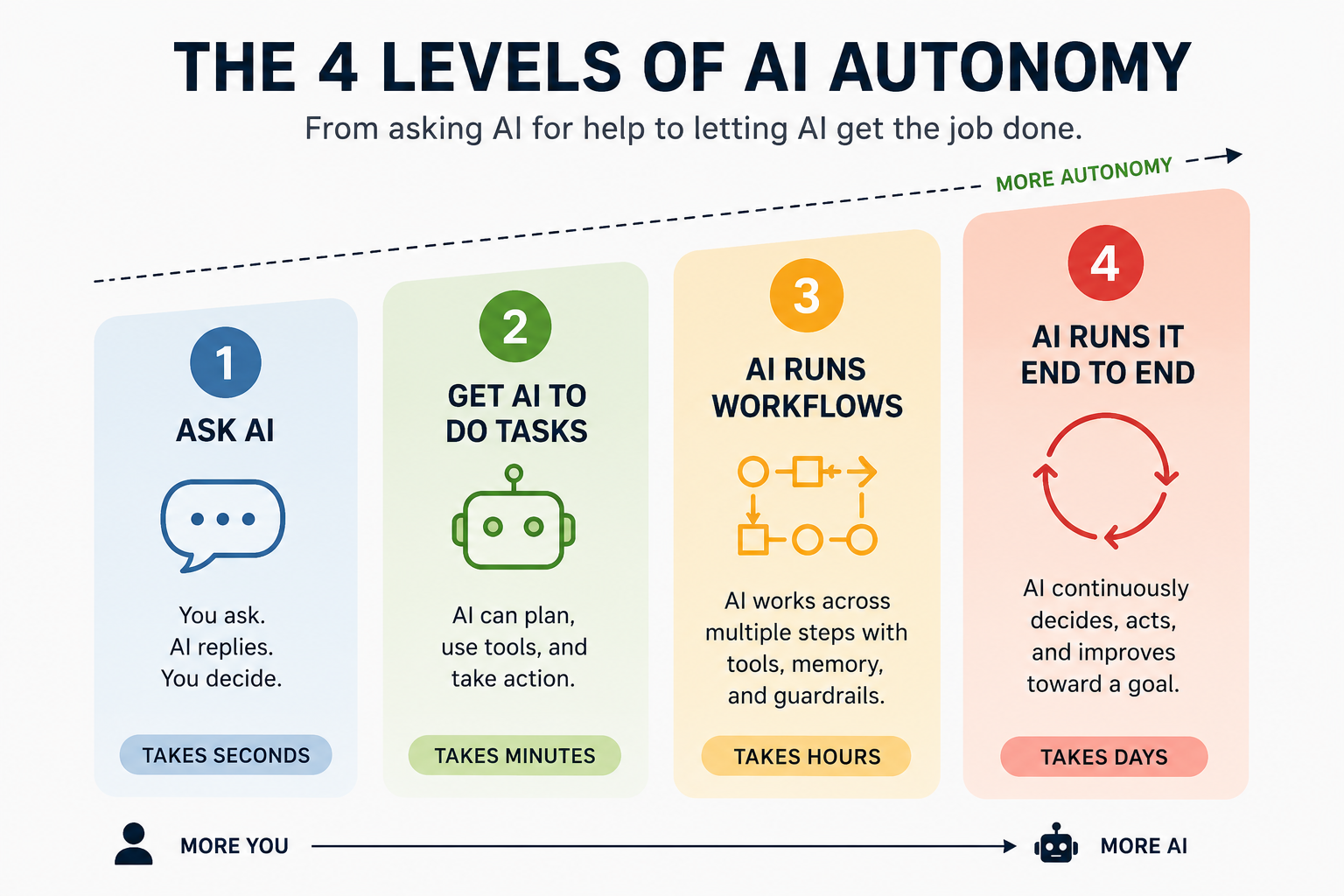 --- ## The Real Skill Is Not Prompting. It Is Designing Work. As AI capabilities continue to advance, the most valuable skill will not be writing prompts. It will be understanding how work actually happens. Prompting remains useful, but the deeper capability is knowing how to: 1. Break work into steps 1. Define quality standards 1. Create feedback loops 1. Assign responsibilities 1. Establish guardrails 1. Determine where human judgment is essential This applies across every profession. Whether you are a founder, marketer, consultant, analyst, developer, operator, or executive, the key question is no longer: "How do I use AI?" The better question is: "Where can AI move from answering to executing?" That question forces you to examine your workflows differently. ***What tasks do you repeat every week? What consumes disproportionate amounts of time? What activities involve research, drafting, formatting, analysis, or review? What work is valuable but not the highest use of your attention?*** Those are your opportunities. Do not start by trying to automate everything. Start with one workflow. Document the process. Identify repetitive steps. Determine where human judgment is required. Then introduce AI gradually. If you create content, begin with research. Then outlining, drafting, repurposing, performance analysis. Over time, isolated prompts become a repeatable content engine. The same principle applies to operations, sales, customer service, finance, and strategy. The people who gain the greatest advantage from AI will not necessarily be those using the newest tools. They will be the ones who understand how to combine human judgment with machine execution. AI is evolving from assistant to operator. The winners will be those who learn how to supervise that operator effectively. [](https://cryptostoicmedia.com/)