The more time you spend watching people navigate decentralized finance (DeFi), the more obvious it becomes: *survival onchain is less about pure technical ability and far more about **mindset***. Onchain survival is a succession of lessons that most be lived to be understood. This isn't something you learn by static: reading tutorials, watching videos or memorizing technical patterns. > If there is no trading history, technical analysis is useless. Hence, the need for a different kind of mindset. Those who survive are willing to experiment with new protocols. They are willing to put test capital on the line. They are willing to be wrong on an asset thesis. Most importantly, they are willing to treat loses as raw information. ## The Trap of the Assembly-Line Trader People approach the blockchain with an assembly-line mentality. They demand an exact step-by-step instruction manual: 1. Buy Token X at Support level Y. 1. Yield farm at Protocol Z for a guaranteed 20% APY. 1. Cash out perfectly at the top. They expect trading to be predictable instead of probabilistic. That mindset is a fast track to liquidation. Traditional institutions and schools reward predictability and process compliance. But the blockchain operates on a entirely different architecture: it is inherently probabilistic. Onchain dynamics are governed by game theory, shifting liquidity pools, miner/maximal extractable value (MEV) bots, and human emotion. When an assembly-line trader hits an imperfect outcome—like a sudden gas spike or an unexpected token migration—they conclude the market is fundamentally broken and quit. The trader with the mindset we will develop below looks at the exact same transaction failure and asks: ***“What did the mempool just teach me?”*** --- ## The On-chain Decision Making Pillars ### Thinking in Bets Every single interaction with a decentralized exchange (DEX) or smart contract is a wager under uncertainty. The world of Web3 provides us with incomplete information, hidden developer allocations, malicious code risks, and market randomness. To survive, you must separate decision quality from outcomes.  A structurally sound trade based on deep liquidity analysis, contract audits, and clear volume metrics can still result in a loss due to an *unforeseen exploit or a macroeconomic dump*. Conversely, buying a un-audited meme coin on a whim can make someone a millionaire overnight. *The result of a single trade does not tell you if your strategy was right.* If you use a protocol once, experience a negative slip, and declare the ecosystem useless, you are judging an entire financial framework based on a single play. An adaptive mindset treats a poor outcome purely as data: - Was my slippage tolerance set too high? - Did I miscalculate the liquidity depth? - Should I have split my order across multiple automated market makers (AMMs)? Every swap is a bet. Your skill lies in marginally improving your statistical odds with each dynamic attempt. *Expect losses,* cut them without emotional ego, and move forward. ### Evolving via Bayesian Updating ***Bayesian thinking*** is the art of updating your beliefs continuously as new information arrives. You start with a market view, observe fresh data, and dynamically adjust your exposure. The onchain ecosystem is the ultimate Bayesian training ground. It moves significantly faster than traditional legacy finance; a single afternoon in crypto can contain a year’s worth of structural volatility. Developer announcements, multi-sig wallet movements, cross-chain bridge flows, and sudden protocol forks hit the market simultaneously. Rigid thinking here is financially fatal. You need a firm conviction to deploy capital, but you must also know exactly what data points will change your mind. Marrying a position is how you become exit liquidity. Hope has never been a market strategy and will never be. You do not remained anchored to a fixed mindset when the cost of exploring new ideas is significantly lower than Tradfi. With a web3 wallet, you can test a theory with minimal capital across five different layer-2 chains simultaneously. You can sample low-liquidity pairs, interact with alpha versions of yield aggregators, and track wallet distributions in real time. 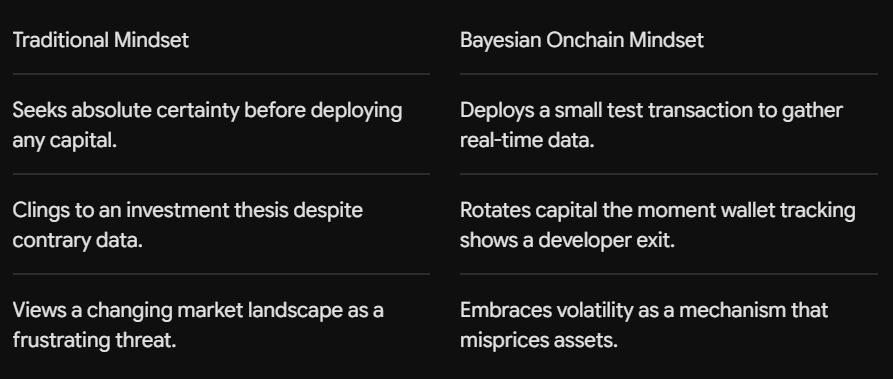 If your initial macro thesis on an ecosystem begins to show weakness under on-chain inspection, you don't defend it; you pivot. If wallet tracking reveals a massive whale accumulation that contradicts market sentiment, you update your probabilities. AI and data tools allow you to scrape onchain transactions instantly. The winner is simply the trader who updates their market bias the fastest based on the new evidence presented. ## Applying Filters The defining characteristic of trading onchain is not scarcity—it is absolute, *overwhelming abundance.* Everything is entirely public. Every transaction hash, smart contract deployer, token creation, and liquidity addition is recorded onto an open ledger. But this extreme transparency creates a massive filtering problem. The vast majority of on-chain activity is deliberate noise: - wash trading, - programmatic bot volume, - promotional shill campaigns, and - rug-pull setups. The advantage shifts completely from information access to analytical judgment. You must observe the ecosystem like Sherlock Holmes, hunting for the specific, quiet clues that others overlook. 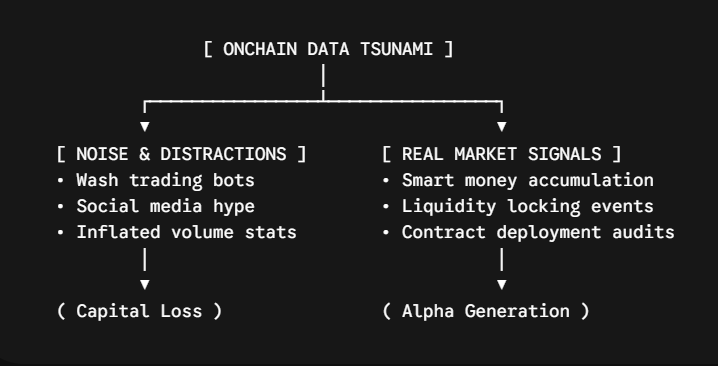 Holmes famously solved mysteries by realizing that the most important clue was often* the dog that didn't bark*. In DeFi, you must look for similar anomalies: - Why is the transaction volume skyrocketing while unique active wallets remain flat? - What critical dependencies are hidden within this smart contract's governance parameters? - Which wallets are silently accumulating an asset without posting about it on public forums? Do not waste time looking for a single magic charting indicator or a universal automated trading bot that promises effortless riches. The blockchain rewards highly observant participants who treat each token launch or liquidity pool as a unique puzzle requiring customized filters. --- ## The Ultimate On-chain System To thrive in the decentralized economy, update your mental software to this three-part operating system: **Think in bets:** Accept that every deployed transaction is an exercise in probability, and detach your emotional health from short-term randomness. **Update like a Bayesian**: Treat your market thesis as flexible clay, re-shaping it instantly as fresh block data emerges. **Observe like Sherlock Holmes**: Ignore the screaming headlines and scrutinize the underlying ledger to find the micro-signals that specify real value. The great divide on the blockchain is between those who treat the network mechanically and those who treat it with adaptive intelligence. One group sits frozen at the first sign of an error or market drop, waiting for a savior or a perfect manual. The other group studies the volatility, updates their risk parameters, calculates the new odds, and keeps moving. Most of us were trained in general intelligence, but ***adaptive intelligence*** is defined as the mental capacity to change one's behavior, attitudes, and skills to effectively respond to current environmental demands and anticipate future real-world problems. This is a dynamic interaction between a person, their task, and their situation. Most people do not find themselves in situations that warrant them to think this way. The financial markets is one of those arena plagued by randomness, and a perfect ground for adaptive intelligence. For a tailored and adaptive approach to Onchain Crypto, [download](https://cryptostoicmedia.com/)our Safety Starter Kit. [](https://cryptostoicmedia.com/)