A crypto wallet can look simple from the outside. You download an app. You create a wallet. You see an address. You may see balances, buttons, tokens, and transaction history. It can feel similar to a banking app, payment app, or online account. But a crypto wallet is not just another app. It's access to a suite of financial tools. That is one of the first things beginners need to understand. A company usually controls a normal app account. If you forget your password, you may be able to reset it. If something goes wrong, support can help. If there is fraud, a bank or platform may have a dispute process. Crypto wallets can work differently, especially when you use a self-custody wallet. In crypto, your wallet is the tool that helps you control blockchain addresses, manage access, receive assets, send assets, and approve actions. That control can be useful, but it also creates responsibility. Before using a crypto wallet, beginners should understand what it does, what it does not do, and what must never be shared. Current wallets are no longer rails to just on/off - ramp cash, but the integration of prediction markets, perps trading, social chats, identity layer, etc. Wallets are not just basic anymore but combing financial, social, and entertainment activities all in one. **A Wallet Does Not Work Like a Normal App Account** Most beginners think a wallet “holds” crypto the same way a physical wallet holds cash. That explanation is useful at first, but it is not fully accurate. In many crypto systems, the assets are recorded on a blockchain. Your wallet app helps you access and control the address associated with those assets. The wallet lets you create addresses, view balances, connect to applications, and authorize actions. The important idea is control. A wallet helps prove that you have permission to take actions from a specific blockchain address. Those actions might include sending funds, signing a message, approving token access, or interacting with an application. That is why ***wallet security*** matters so much, particularly with the integration of social activities. If someone gains control of the information that controls your wallet, they may be able to move assets or authorize actions without your permission. ***Do not treat a crypto wallet like any other app. Treat it like a control system for digital assets and permissions.*** **The Public Address: What You Can Share Carefully** A wallet address is like a destination on a blockchain network. It is usually a long string of letters and numbers. People can use it to send assets to you. You may also use it to look up public transaction activity on a blockchain explorer. Your public address is not the same as your seed phrase or private key. In many cases, sharing a public address is necessary to receive crypto. But even public addresses should be handled thoughtfully because they can reveal activity linked to that address in the form of ***metadata***. For example, if you post a public address online, others may be able to view balances and transaction history associated with that address. That does not automatically give them control, but it can reduce privacy and attract unwanted attention. ***A public address can receive funds, but sharing it publicly may expose activities linked to that address.*** **The Private Key and Seed Phrase: What You Must Protect** The most important wallet lesson is simple:***Never share your seed phrase or private key.*** A* private key* is sensitive information that can authorize control over a wallet address. A seed phrase, sometimes called a ***recovery phrase***, is a set of words that can restore access to a wallet. To a beginner, a ***seed phrase*** may look like a strange backup code. But it is much more serious than that. If someone gets your seed phrase, they may be able to restore your wallet on another device and move funds. If someone gets your private key, they may be able to control the associated address. This is why seed phrase scams are so common. Fake support accounts, fake wallet websites, fake recovery services, and phishing pages may ask you to “verify,” “sync,” “restore,” or “secure” your wallet by entering your recovery words. No legitimate support person needs your seed phrase. No real wallet provider should ask you to send it in a message. No website should ask for it after wallet setup because someone in a chat told you to enter it. ***Your seed phrase is not a password. It is wallet-control information. Protect it accordingly, as it is your last line of defense.*** **Custodial Accounts vs. Self-Custody Wallets** Not every crypto experience uses the same kind of wallet setup. Your intended activity should determine the type of wallet setup. A beginner may first encounter crypto through an exchange account. In that case, the exchange may hold assets on the user’s behalf. This is often called custodial access. The user logs in with an account, password, and security settings, while the platform manages custody behind the scenes. This is the highly recommended starting point. A self-custody wallet is different. With self-custody, the user controls the wallet’s recovery information. That gives the user more direct control, but also more responsibility. If the user loses the seed phrase, shares it with a scammer, signs a dangerous approval, or sends funds incorrectly, there may not be a simple recovery path. Neither model should be treated casually. Custodial accounts create platform risk. Self-custody creates user-control risk. Beginners should understand both before moving assets or connecting wallets. The goal is not to say one model is always right for everyone. The goal is to understand who controls what. ** Before using any crypto service, ask: who controls the asset, who controls access, and what happens if something goes wrong?** Before you create or use a crypto wallet, build your safety process. [Download](https://cryptostoicmedia.com/) the **FREE Kit** [](https://cryptostoicmedia.com/) These actions are not the same. A common beginner mistake is treating every wallet pop-up like a normal notification. It is not. A wallet prompt may be asking for permission, proof, access, or movement of value. **When your wallet opens, slow down and read what action is being requested.** 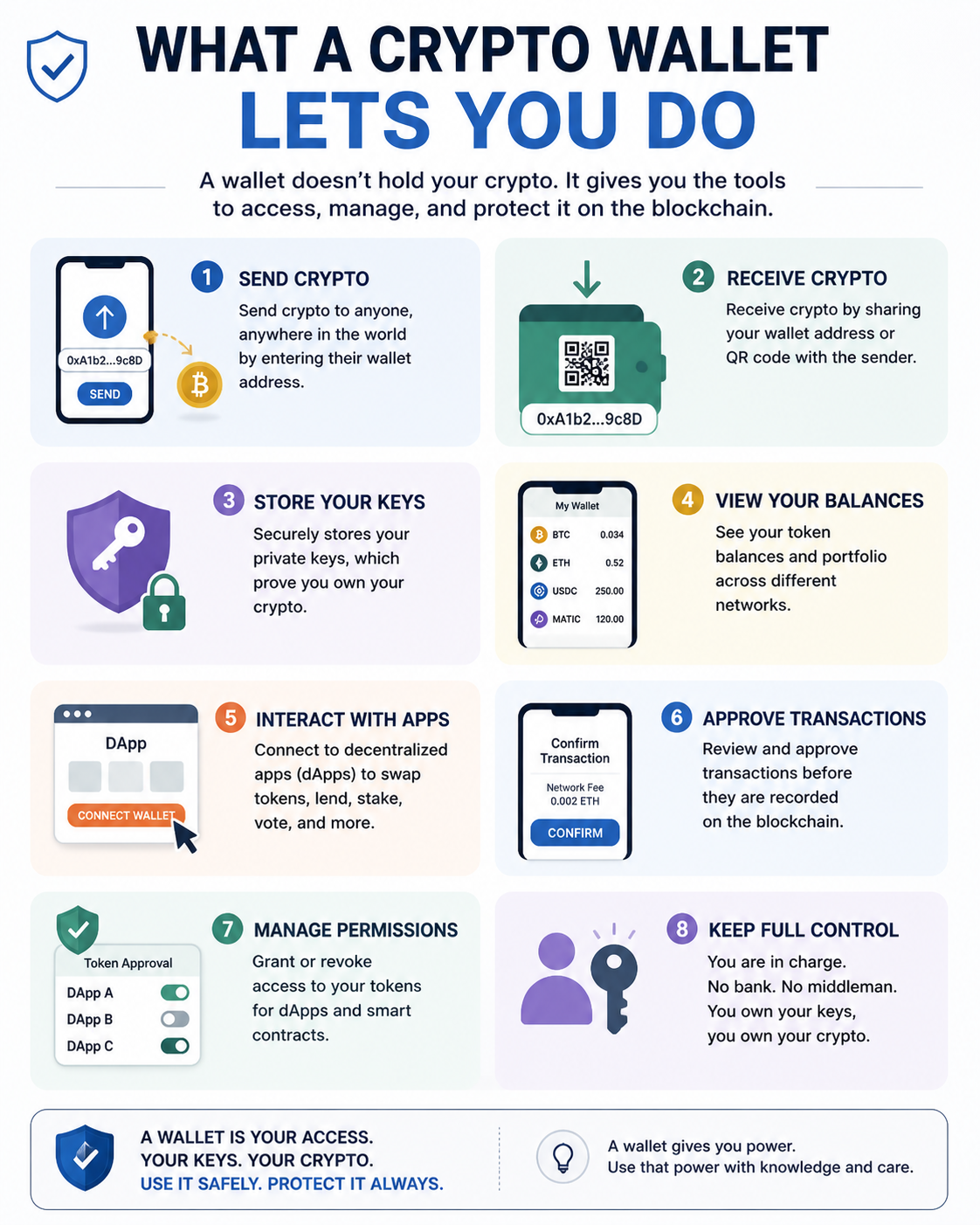 The important point is this: A wallet type does not automatically make you safe. A hardware wallet can be used incorrectly. A mobile wallet can be phished. A browser wallet can connect to a fake site. A custodial account can be compromised if the login is weak or the platform is unsafe. **The safest wallet is not just the one you choose. It is the one you understand and use with guardrails.** **What a Wallet Does Not Do** A crypto wallet is useful, but it does not remove risk. A wallet does not automatically know whether every website is safe. It does not guarantee that every token is legitimate. It does not always explain risks in beginner-friendly language. It may not stop you from signing something harmful. It cannot always reverse a transaction after you send it. This is why beginners need safety habits before wallet interactions. Do not assume the wallet will protect you from every mistake. You still need to verify links, protect your seed phrase, use small test transactions, understand approvals, and avoid urgent private messages from fake support accounts. **A wallet is a tool, not a safety guarantee.** **Five Points On Wallet Safety** Before using a crypto wallet, every beginner should understand these five points: 1. Your public address is not your seed phrase. 1. Your seed phrase and private key must never be shared. 1. Wallet prompts are permission requests, not normal pop-ups. 1. Sending funds to the wrong address or network is irreversible. 1. Fake support, fake links, and fake wallet apps are common beginner traps. You do not need to master every technical detail before learning crypto. But you do need enough understanding to avoid handing over control. That is the purpose of wallet education. It gives you the ability to pause, check, and ask better questions before taking action. A crypto wallet is one of the most important tools you will forever need, hence wallet education is not optional. It can help you receive assets, send assets, connect to applications, and prove control over a blockchain address. But it also introduces responsibility. A wallet is not just an app. A seed phrase is not just a password. A wallet prompt is not just a notification. The safest path is to understand the wallet before using it. A beginner does not become safe by downloading a wallet. A beginner becomes safer by using a wallet with the right guardrails. [](https://cryptostoicmedia.com/)